
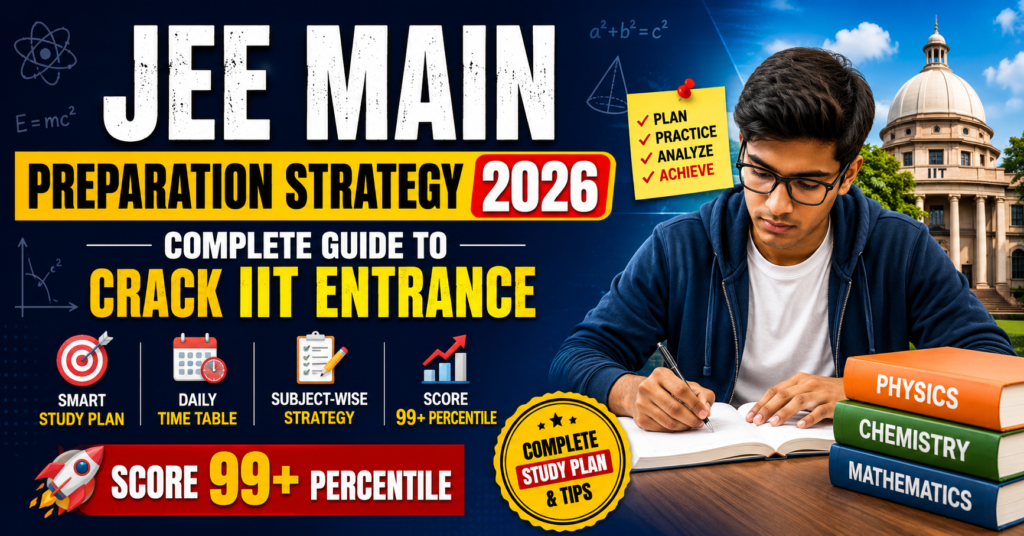
JEE Main Preparation Strategy: Complete Guide to Crack IIT Entrance
1. Deconstructing the JEE Main Exam Pattern
Before drawing up a single study schedule, you must internalize the structural landscape of the Computer-Based Test (CBT). The architecture of the question paper dictates exactly how you should distribute your time during preparation and inside the examination hall.
| Component | Operational Structure & Marking Analytics |
|---|---|
| Subject Distribution | Physics, Chemistry, and Mathematics (30 Questions assigned per subject). |
| Mandatory Execution | Candidates must attempt 25 questions out of the 30 provided per subject. |
| Section Layout | Section A: 20 compulsory Multiple Choice Questions (MCQs). Section B: 10 Numerical Value Questions (NVQs), where candidates must choose exactly 5 to attempt. |
| Marking Metrics | +4 for an accurate response. -1 for an incorrect response (applicable to both MCQs and NVQs). 0 for unattempted questions. |
| Total Evaluation Scale | Maximum potential score of 300 marks across 75 total attempted questions. |
The Section B Strategy
The introduction of negative marking to the Numerical Value Questions (Section B) changed exam dynamics. You can no longer treat NVQs as free guesses. Because you only need to answer 5 out of 10 questions, Section B offers a major strategic advantage: selective filtering. Your preparation should train you to scan these 10 options rapidly and isolate the 5 questions that match your absolute strongest sub-topics, avoiding calculations with high error risks.
2. The 12-Month Macro-Phased Preparation Matrix
To prevent cognitive overload, your macro timeline must be split into three distinct, non-overlapping operational phases. Each phase demands a fundamental shift in how you study and solve problems.
Phase 1: Concepts
Months 1 to 4
• 100% NCERT Mastery
• Derivation Layouts
• Core Variable Graphs
Phase 2: Application
Months 5 to 8
• Topic-wise PYQs
• Speed-Drill Exercises
• Variable Isolation
Phase 3: Optimization
Months 9 to 12
• Simulated Exam Environments
• Micro-Error Tracking Logs
• Aggressive Weak-Spot Fixes
Phase 1: Deep Core Concept Building (Months 1–4)
The primary objective of this phase is absolute cognitive clarity.
- The NCERT Anchor: Treat NCERT textbooks as your structural core, particularly in Chemistry and Physics. Read them actively by annotating text, questioning assumptions, and mapping out structural layouts of derivations.
- Active Notebook Management: Maintain two distinct sets of notebooks: a Comprehensive Concept Ledger for detailed derivations, proofs, and edge cases, and a Formula Registry reserved exclusively for quick reference definitions and equations.
- Mathematical Proofs: Avoid memorizing formulas without understanding their origin. Deriving an equation yourself trains your brain to spot the underlying mechanics of a problem when the exam tweaks the variables.
Phase 2: High-Volume Application & Speed Drills (Months 5–8)
During this phase, you transition from understanding theory to executing problem-solving algorithms efficiently.
- The 3-Tier Problem System: Categorize every practice problem set into three distinct tiers:
- Tier 1: Direct application questions (to build baseline confidence).
- Tier 2: Multi-concept hybrid questions (the standard format for JEE Main MCQs).
- Tier 3: Advanced-level analytical problems (to ensure deep understanding and prep for tough shifts).
- Time-Bound Variable Isolation: Stop solving questions casually. Use a stopwatch. Allocate exactly 2 minutes per MCQ and 3 minutes per NVQ during your daily practice sessions to replicate real exam pressure.
- The PYQ Mandate: Integrate Previous Year Questions directly into your daily topical practice rather than leaving them all for the end of the year.
Phase 3: Revision Optimization & Mock Simulations (Months 9–12)
The final phase focuses on maximizing your test-taking efficiency and fine-tuning your performance.
- Systematic Diagnostic Testing: Transition to writing full-length mock tests 2 to 3 times a week, ensuring you take them precisely during NTA match slots (9:00 AM – 12:00 PM or 3:00 PM – 6:00 PM) to sync your biological clock.
- The Error Log Protocol: For every test you complete, spend a minimum of two hours analyzing your mistakes. Classify every wrong answer into one of three buckets: Conceptual Blindspot, Calculation Slip, or Misread Strategy.
3. High-Yield Subject Strategies & Topic Architecture
Physics: Developing Algorithmic Intuition
Physics requires translating real-world physical scenarios into precise mathematical models.
High-Weightage Core Pillars
- Mechanics: Focus heavily on Conservation of Linear Momentum (CLM), Work-Energy Theorem applications, and Rotational Dynamics.
- Electrodynamics: Prioritize Gauss’s Law applications, Kirchhoff’s laws in complex circuits, and electromagnetic induction loops.
- Modern Physics: This is a goldmine for high-yield points. Master Bohr’s atomic model, the photoelectric effect equation, and radioactive decay laws. It requires less calculation time for the marks it yields.
Tactical Action Plan
Never look at a physics solution before spending at least 5 minutes trying to crack it yourself. When stuck on complex mechanics or electrodynamics problems, break them down systematically: draw a clear free-body diagram, isolate your active forces, map out the boundary constraints, and only then write your governing equations.
Chemistry: Mastering the Three Pillars
Chemistry is frequently the deciding factor for a 99+ percentile rank. It provides the highest rate of return on your time investment, allowing you to secure crucial marks quickly.
Physical Chemistry
• Mathematical Models
• State Systems & Kinetics
• Strict Unit Conversions
Organic Chemistry
• Stepwise Pathway Mapping
• Electron Flow & GOC
• Named Reagent Routing
Inorganic Chemistry
• Active Trend Profiles
• Crystal Field Properties
• NCERT Exceptions Log
1. Physical Chemistry
Treat this sub-discipline like Physics. Focus your efforts on mastering state systems and mathematical models.
- Critical Focus: Chemical and Ionic Equilibrium, Thermodynamics, Electrochemistry, and Chemical Kinetics.
- Execution Strategy: Build a highly organized inventory of unit conversions (e.g., converting gas constants from Joules to calories or liter-atmospheres). A large percentage of errors in Physical Chemistry stem purely from mismatched units in calculation steps.
2. Organic Chemistry
Stop trying to memorize individual reactions. Instead, focus on learning the underlying electronic movements that drive them.
- Critical Focus: General Organic Chemistry (GOC) principles like inductive, resonance, and hyperconjugation effects, alongside named reaction pathways (e.g., Aldol Condensation, Hoffmann Bromamide Degradation).
- Execution Strategy: Map out complete reaction chains on large charts. Track how a single hydrocarbon conversion moves through different functional groups based on specific reagents.
3. Inorganic Chemistry
This area rewards consistent, active recall and thorough reading.
- Critical Focus: Coordination Compounds, Chemical Bonding, and d- and f-block element profiles.
- Execution Strategy: Read your NCERT textbooks line-by-line. Highlighting isn’t enough; write down structural exceptions, color changes in compounds, and trends in ionization enthalpy directly into a dedicated notebook.
Mathematics: Rigorous Pattern Recognition
JEE Main Mathematics has become increasingly challenging over the past few years, shifting toward lengthy, calculation-heavy problems. To tackle it successfully, you need excellent pattern recognition and strong endurance.
High-Weightage Core Pillars
- Calculus: Master Continuity and Differentiability, Definite Integrals as limits of sums, and solving Differential Equations.
- Coordinate Geometry: Focus on tangent and normal equations for Conic Sections (Parabola, Ellipse, Hyperbola).
- Algebra: Prioritize Matrices and Determinants, Vector Algebra, and 3D Geometry—these are highly scoring, algorithmic, and predictable topics.
Tactical Action Plan
You cannot learn math by just reading solutions. Aim to solve a minimum of 25 complex questions daily without a calculator. Work on developing “alternate paths” for problems: when a direct algebraic derivation gets too messy, see if you can use option elimination, value substitution, or geometric graphs to find the answer faster.
4. The Synchronized 14-Hour Daily Timetable
To execute this strategy smoothly, you need a balanced, sustainable daily schedule. This 14-hour timeline uses a block-scheduling method to keep your mind sharp and prevent burnout.
| Time Allocation | Strategic Activity & Focus Focus Block |
|---|---|
| 06:00 AM – 07:00 AM | Active Retrieval & Core Formula Audits |
| 07:00 AM – 10:00 AM | Block A: Physics Analytical Engineering |
| 10:00 AM – 11:00 AM | Strategic Cognitive Decompression (Break) |
| 11:00 AM – 02:00 PM | Block B: Mathematics Algorithmic Execution |
| 02:00 PM – 03:00 PM | Nutritional Reset & Midday Rest |
| 03:00 PM – 06:00 PM | Block C: Chemistry Dual-System Study |
| 06:00 PM – 07:00 PM | Cardiovascular / Physical Reset |
| 07:00 PM – 10:00 PM | Block D: Mixed Problem-Solving & Error Auditing |
| 10:00 PM – 10:30 PM | Daily Review & Next-Day Horizon Setup |
| 10:30 PM | Lights Out / Mandatory Sleep Window |
Breakdown of Daily Study Blocks
- Morning Activation (06:00 AM – 07:00 AM): Do not learn new content here. Use this hour for active retrieval—blank sheet testing of formulas, inorganic reaction exceptions, and vocabulary notes.
- Block A: Physics (07:00 AM – 10:00 AM): Your brain is freshest now, making it the perfect time for deep analytical engineering concepts and solving tough numerical problems.
- Block B: Mathematics (11:00 AM – 02:00 PM): Use this block for intense, high-volume calculation practice to train your mental stamina during peak daylight hours.
- Block C: Chemistry (03:00 PM – 06:00 PM): Split this block down the middle: devote 90 minutes to conceptual organic mechanism routing and 90 minutes to high-density inorganic memorization.
- Block D: Application & Auditing (07:00 PM – 10:00 PM): Set a timer and solve mixed question sets. Spend the final 45 minutes updating your error log based on any mistakes made during the session.
5. Advanced Exam Hacks for a 99+ Percentile
The Two-Pass Examination Strategy
Never solve a JEE Main paper in a straight line from question 1 to 75. Instead, use a two-pass approach to navigate the test efficiently:
- Pass 1 (The First 60 Minutes): Scan the entire paper and solve only the single-step, direct conceptual questions—such as inorganic chemistry trends, formula-driven physics questions, and matrices. Skip anything that looks lengthy. This helps you bank immediate marks and builds positive momentum.
- Pass 2 (The Next 100 Minutes): Go back to the questions you skipped but know how to solve. These are your multi-step calculus problems, complex mechanics systems, and organic synthesis pathways.
- The Final 20 Minutes: Clean up any remaining questions, verify tricky numerical values, and double-check your Section B selections.
The Art of Strategic Guessing
If you can confidently eliminate two options on an MCQ through dimensional analysis, boundary constraints, or extreme-value testing, always take the guess. Statistically, over a large enough sample of questions, the +4 / -1 marking scheme works in your favor when choosing between two remaining options.
6. Curated Reference Literature
Avoid the trap of collecting too many study materials. Focus on mastering a few high-quality resources instead of skimming through dozens of books.
- Physics: Use Concepts of Physics by H.C. Verma for solid foundational theory, and Understanding Physics by D.C. Pandey to practice structured problem-solving.
- Chemistry: Treat NCERT Exemplar as mandatory reading. Supplement it with Organic/Physical Chemistry by O.P. Tandon for deeper theoretical background and extra practice problems.
- Mathematics: Start with Comprehensive Mathematics by R.D. Sharma to build basic skills, and move to the Cengage Series to master advanced pattern recognition and challenging problem types.
7. Critical Pitfalls and How to Avoid Them
- The Illusion of Competence: Reading a solution and saying “ah, I get it” is not the same as being able to solve it yourself. If you need to look at a solution step, hide it immediately and force yourself to rewrite the entire derivation from scratch on a blank page.
- Ignoring Mock Analysis: Taking a mock test without analyzing it is a waste of three hours. Your growth doesn’t happen during the test itself; it happens when you figure out exactly why you missed a problem and adjust your approach so you don’t make that mistake again.
- Escapism in Strong Subjects: It is natural to spend more time studying the subject you like best. However, JEE Main demands balanced score profiles across all fields. If you find yourself avoiding a weak subject, change your schedule to tackle that specific topic first thing in the morning when your energy is highest.
Final Strategy: The Final 30-Day Countdown
As you enter the final month before the exam, stop learning new concepts entirely. Trying to pick up unfamiliar topics at this stage only creates unnecessary anxiety and dilutes your focus. Shifting your focus toward protecting and sharpening your existing strengths is what keeps your mind steady.
Spend your final 30 days reviewing your formula registry, reading through your inorganic chemistry notes, and working through your personal error logs. Treat every mock test like the real exam, and analyze every mistake with curiosity rather than frustration. JEE Main is a test of endurance and discipline just as much as it is an academic exam. Trust your system, stay consistent with your routine, and let your structured preparation deliver the results you’ve worked for.