ICSE vs CBSE Detailed Comparison Guide
Choosing a school board ranks among the most consequential decisions parents make in a child’s academic life. It determines not just the syllabus, but the exam philosophy, the pace of learning, and how seamlessly a family can relocate without disrupting a child’s education. CBSE and ICSE remain India’s two most widely chosen boards, and while both aim to produce well-rounded students, they arrive at that goal through markedly different routes.
This comparison examines both boards in depth: curriculum design, exam structure, English language pedagogy, and how each aligns with competitive exams like JEE and NEET. The goal here is clarity, not opinion, so parents can weigh the evidence and decide what genuinely suits their child.
Governance and Reach: Who Sets the Rules
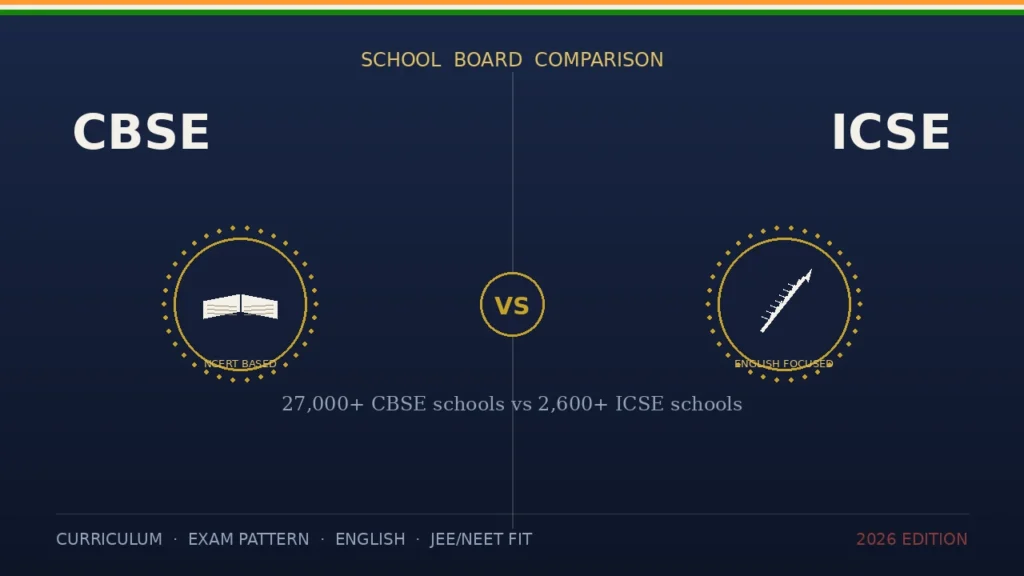
CBSE, the Central Board of Secondary Education, is India’s largest school board by a considerable margin, with over 27,000 affiliated institutions nationwide. As a government-administered body, it adheres closely to the NCERT curriculum, which lends it an unmatched degree of national standardisation. A CBSE classroom in Chennai and one in Chandigarh will, in most subjects, be working through nearly identical material.
ICSE, formally the Indian Certificate of Secondary Education, operates under a different model entirely. It is governed by CISCE, the Council for the Indian School Certificate Examinations, a private body rather than a government department. With roughly 2,600 affiliated schools, ICSE’s footprint is considerably smaller, but its schools enjoy more latitude in selecting textbooks, provided they satisfy the syllabus CISCE prescribes.
ICSE vs CBSE: Full Comparison Table
| Parameter | CBSE | ICSE |
|---|---|---|
| Governing body | Central Board of Secondary Education, government administered | CISCE, an independent council |
| Affiliated schools | Over 27,000 | Approximately 2,600 |
| Curriculum philosophy | Standardised nationwide, built on NCERT | Broader in scope, with greater depth per subject |
| English language emphasis | Functional and structured | Strongly literary, with an emphasis on written expression |
| Subjects at Class 10 | A tighter, more focused subject count | Typically six, including Socially Useful Productive Work |
| Best suited for | Students preparing for JEE, NEET, or CUET | Students drawn to language, humanities, and analytical depth |
| Exam pattern in 2026 | Two Class 10 board exam attempts, one for Class 12 | A single annual board exam, unchanged for 2026 |
| Pass percentage trend | Generally higher, given a more predictable format | Somewhat lower, owing to broader, more demanding papers |
| Ease of switching schools | Comparatively simple, thanks to nationwide uniformity | More difficult, since content and depth vary by school |
| Alignment with competitive exams | Strong, since NCERT content maps directly onto JEE and NEET | Moderate, often requiring supplementary bridging material |
Board affiliation, however, tells only part of the story. The gap between a strong school and an underperforming one, within either system, can matter more than the governing body itself.
Where the Curricula Genuinely Diverge
CBSE’s syllabus is deliberately tight. Its topics unfold in a predictable sequence, which not only eases transitions between CBSE schools but also explains why its content dovetails so neatly with national entrance exams. NCERT textbooks form the backbone of JEE, NEET, and most major competitive tests, meaning a CBSE student’s day-to-day coursework already overlaps substantially with exam preparation.
ICSE takes the opposite approach, favouring breadth over economy. Students cover more ground within a single subject and are expected to produce longer, more analytical written responses rather than brief, formulaic ones. Mathematics, for instance, incorporates additional topics such as Statistics and advanced Geometry at the Class 10 level, areas CBSE treats with a lighter touch. Science papers follow suit, demanding a depth of preparation that builds a genuinely robust foundation, though at the cost of additional time and effort.
The English Language Divide
Nowhere do the two boards diverge more sharply than in their treatment of English. ICSE places considerable weight on both language and literature, pushing students toward detailed, analytical writing that develops over years of sustained practice. Families with an eye on law, journalism, or study abroad often find this emphasis pays real dividends later.
CBSE’s approach, by contrast, is more utilitarian. Comprehension, grammar, and functional writing dominate, within a format that tends to be structured and predictable. This makes it comparatively easier to score well, though it cultivates somewhat less depth in expressive writing than ICSE demands.
What Changed for 2026
CBSE introduced a significant shift this year: Class 10 students may now attempt their board exam twice, once in February and again in May, with the higher of the two scores counted toward the final result. Class 12 remains unchanged, with a single annual examination.
ICSE has not followed suit. Both Class 10 and Class 12 under CISCE continue to operate on a single annual exam. That said, ICSE has quietly moved its own question papers toward more competency-based, application-driven formats, a shift that mirrors CBSE’s broader direction even as the exam structure itself stays fixed.
Which Board Serves Competitive Exam Aspirants Better
For families with JEE, NEET, or CUET on the horizon, CBSE offers a tangible practical advantage. These entrance exams are constructed directly from NCERT material, so a CBSE student’s regular coursework tracks closely with what these tests actually assess.
This is not to say ICSE students are disadvantaged outright. Its broader coverage of science and mathematics builds strong fundamentals, and plenty of ICSE graduates go on to excel in these same exams. They simply tend to require additional bridging work to match the specific question style and format these national tests employ.
The same logic extends to many state-level government exams, including SSC and various state PSC recruitment tests, whose syllabi frequently echo NCERT content. Here too, CBSE students often carry a modest head start.
Moving Between Boards
Transitioning from ICSE to CBSE tends to be the smoother of the two moves, particularly if it happens before Class 9. Because CBSE’s syllabus is lighter in several areas, students typically need only to recalibrate their pace rather than relearn entire topics from scratch. Hindi is one notable exception, since some ICSE schools do not offer it as a compulsory subject.
The reverse transition, from CBSE to ICSE, proves considerably harder. ICSE’s heightened expectations around English and its broader subject coverage often demand genuine catch-up work, particularly in written expression and expanded syllabus areas. Both transitions grow more difficult after Class 9, once board-specific exam preparation begins in earnest.
Making the Right Call for Your Child
No universal answer exists here, and any source claiming otherwise is oversimplifying a genuinely individual decision. Children who thrive on structure and predictability often flourish under CBSE. Those with a natural affinity for reading, writing, and multidisciplinary exploration frequently find ICSE more engaging.
Start by considering your child’s inclinations. A student drawn to science and mathematics, with engineering or medicine in mind, will likely find CBSE’s framework genuinely convenient. A student who gravitates toward literature, debate, and sustained subject exploration may find ICSE’s depth more rewarding in the long run.
Practical considerations deserve equal weight. Assess the schools actually available in your city, the calibre of teaching at your shortlisted options, and the likelihood of relocating during your child’s school years. These factors, more often than not, shape outcomes as much as the board’s general reputation.
A Few Additional Facts Worth Knowing
Both boards enjoy recognition across India and abroad. Indian and international universities accept CBSE and ICSE certificates on equal footing, so neither board confers an inherent advantage simply by name.
Fee structures also diverge. ICSE schools, being predominantly private and less standardised in their pricing, tend to charge more than many CBSE institutions, particularly government-run CBSE schools such as Kendriya Vidyalayas.
CBSE students preparing for defence or government service exams often find a further, if modest, advantage, since many state and national exam syllabi lean on the same NCERT foundation CBSE already employs.
Final Thoughts
CBSE and ICSE both produce strong outcomes, and neither board holds a decisive edge across every measure. CBSE offers a tighter, more standardised curriculum closely aligned with India’s major entrance exams. ICSE offers greater subject depth and stronger English proficiency, an advantage that serves students well in humanities, law, or study abroad.
Resist the temptation to decide on reputation alone. Visit the schools under consideration, speak candidly with current parents and teachers, and weigh your child’s genuine learning style. The board provides the framework, but it is the individual school, far more than the name on the certificate, that ultimately shapes a child’s experience.