
Time Management for School Students: A Complete Guide
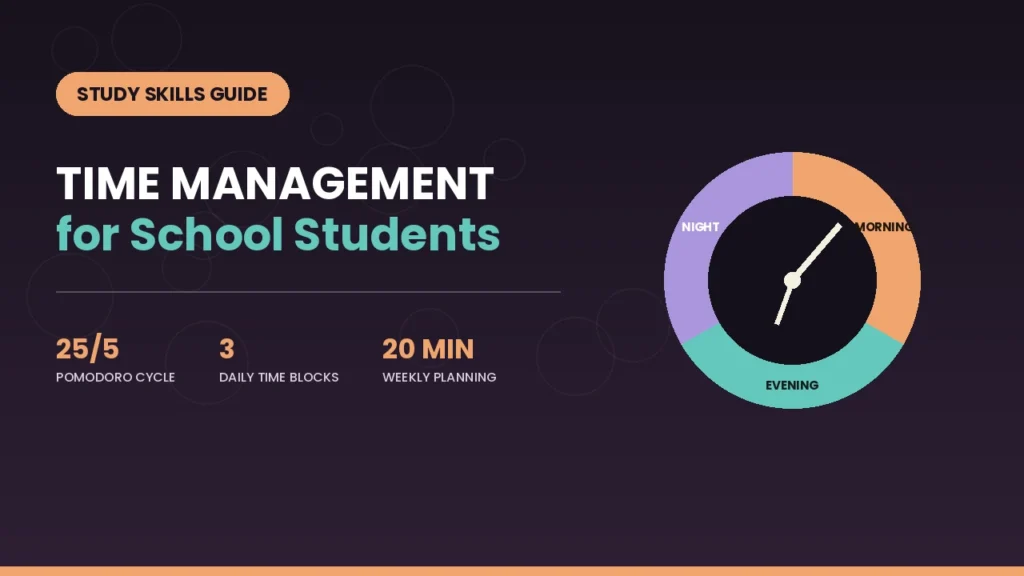
Effective time management for school students rests on four core habits: dividing the day into morning, afternoon, and night blocks with a clear purpose for each, using the Pomodoro Technique of 25-minute focused study sessions followed by 5-minute breaks, prioritizing challenging subjects during peak energy hours rather than at the end of a tired day, and reviewing the week’s schedule every Sunday to plan the days ahead. Students who write down their schedule in a planner or timetable consistently manage time better than those who try to keep it all in their head, and skipping breaks or building unrealistic schedules are the two most common reasons a time management plan falls apart within days. The goal isn’t to fill every hour with study, it’s to make deliberate space for schoolwork, revision, rest, and activities so that nothing important gets pushed aside by last-minute urgency.
Most school students don’t struggle with time management because they’re lazy or unmotivated, they struggle because no one ever taught them a workable system. Between classes, homework, exams, and simply wanting time to relax or see friends, a day can fill up fast without a clear structure behind it. This guide breaks down practical, age-appropriate time management techniques school students can actually use, along with common mistakes worth avoiding.
Why Time Management Matters More Than It Seems
Before diving into specific techniques, it helps to understand what good time management actually achieves, since it’s often misunderstood as simply “being busy.”
- Time management is the ability to plan, organize, and control how time gets spent in order to achieve specific goals, not an instruction to cram more activity into each day.
- Students with a clear daily structure consistently report lower stress and better academic performance than those who study in unplanned, last-minute bursts.
- A written schedule reduces the mental load of constantly deciding what to do next, freeing up energy for the actual work rather than the planning around it.
- Good time management protects space for rest and personal interests too, not just academics, since a schedule that only accounts for schoolwork tends to collapse from burnout within weeks.
Dividing the Day Into Clear Blocks
One of the simplest, most effective structures for school students is breaking the day into three broad blocks, each with a distinct purpose.
- Morning: Focus on attending school and, where possible, a brief review of what was taught that day, keeping this period light to avoid starting the day already fatigued.
- Afternoon and evening: Reserve this block for homework, revision, and any extracurricular or recreational activities, balancing academic work with time to unwind.
- Night: End the day with calming activities such as reading or organizing materials for the next day, which supports better sleep and reduces morning chaos and rushed preparation.
This structure works because it gives every part of the day a clear function, rather than leaving students to figure out what to do in a vague, undivided stretch of free time.
Using the Pomodoro Technique for Focused Study
The Pomodoro Technique remains one of the most widely recommended time management methods for students specifically because it’s simple to start and genuinely effective at maintaining focus.
- Work in focused intervals of 25 minutes, followed by a short 5-minute break, then repeat the cycle.
- After about four cycles, take a longer break of 15 to 30 minutes to properly recharge before continuing.
- This structure works particularly well for subjects or tasks that feel boring or difficult, since a short, defined time block feels far more manageable than an open-ended study session.
- Use an actual timer rather than estimating, since a visible countdown helps maintain commitment to the current task until the interval ends.
Comparing Popular Time Management Techniques
| Technique | What It Involves | Best Suited For |
|---|---|---|
| Time Blocking | Assigning specific hours to specific subjects or tasks | Students who want a clear, visual daily structure |
| Pomodoro Technique | 25 minutes focused work, 5 minute break, repeat | Difficult or boring subjects, building sustained focus |
| Eisenhower Matrix | Sorting tasks by urgency and importance into four categories | Students juggling multiple deadlines and assignments |
| Weekly Planning Session | A short session, often on Sunday, mapping out the coming week | Students who want to avoid last-minute scrambling |
| Task Batching | Grouping similar small tasks together to complete at once | Students with many small assignments across subjects |
Prioritizing Tasks Without Getting Overwhelmed
Not every task on a student’s plate carries equal weight, and learning to sort them matters as much as scheduling time itself.
- Use a simple framework like the Eisenhower Matrix, sorting tasks into what’s urgent and important, important but not urgent, urgent but not important, and neither urgent nor important.
- Spend more of your deliberate planning time on important-but-not-yet-urgent tasks, such as studying steadily for an exam next week, since consistently handling these early prevents them from becoming last-minute emergencies later.
- Break large tasks, like an upcoming exam or a big project, into smaller, specific steps rather than treating them as one intimidating block of work.
- Review your task list regularly rather than only when a deadline is suddenly close, since regular review catches upcoming demands before they pile up unexpectedly.
Building a Weekly Schedule That Actually Sticks
A written schedule only helps if it’s realistic enough to follow consistently, and a few practical habits make the real difference.
- Use a planner, physical or digital, to map out study sessions, deadlines, and activities in one single place you check daily.
- Be honest about how much time you genuinely have available, and avoid overloading your schedule with more than you can realistically complete in a day.
- Schedule your most challenging subjects during your personal peak energy hours, rather than saving them for when you’re already tired.
- Always build in breaks and revision time within the schedule itself, rather than treating them as optional extras to add only if time allows.
- Spend around 20 minutes each week, ideally at the same time such as Sunday evening, reviewing what’s coming up and adjusting your plan for the week ahead.
Managing Distractions During Study Time
Distractions quietly erode far more study time than most students realize, and managing them deliberately matters as much as scheduling itself.
- Keep your phone in another room or switch it to Do Not Disturb during focused study blocks, since even a quick notification check can steal thirty minutes or more of concentration.
- Set up a dedicated, quiet study space that’s free from clutter and interruptions, and let family members know your study hours in advance.
- Focus on one task at a time rather than switching between subjects mid-session, since frequent task-switching reduces efficiency and increases careless mistakes.
- Use simple visual progress trackers, like a checklist or a calendar with checkmarks, since seeing tangible progress tends to reinforce consistency far more than a vague sense of “getting through” the week.
Common Time Management Mistakes to Avoid
A handful of patterns undermine even well-intentioned time management efforts, and recognizing them early helps students avoid repeating them.
- Building an unrealistic schedule that doesn’t account for genuine energy levels or unexpected interruptions, which sets students up to fall behind and abandon the plan entirely.
- Skipping breaks entirely in an attempt to fit in more study time, which typically backfires through fatigue and reduced retention rather than improving results.
- Leaving no dedicated time for revision, treating study sessions purely as forward progress through new material rather than consolidating what’s already been learned.
- Trying to multitask across several subjects or tasks simultaneously, which research consistently shows reduces overall efficiency compared to finishing one task before starting the next.
Frequently Asked Questions
Q. What is the best time management technique for school students?
A. The Pomodoro Technique, working in 25-minute focused intervals followed by 5-minute breaks, is widely recommended for school students because it’s simple to adopt and effectively prevents both distraction and burnout during study sessions.
Q. How should a school student divide their daily schedule?
A. A practical structure divides the day into three blocks: a light morning focused on school and quick review, an afternoon and evening block for homework and revision balanced with recreational activities, and a calm night routine that supports good sleep.
Q. Why do time management plans often fail for students?
A. Plans commonly fail because the schedule itself is unrealistic, skips breaks, or leaves no dedicated time for revision. A sustainable plan accounts honestly for available time, energy levels, and the need for regular rest.
Final Thoughts
Time management for school students isn’t about squeezing more activity into each day, it’s about building a realistic structure that gives schoolwork, revision, rest, and personal time each their proper place. Dividing the day into clear blocks, using focused techniques like the Pomodoro method, prioritizing tasks honestly, and reviewing your schedule weekly together build a sustainable system rather than a rigid one that collapses under the first busy week. Start with just a few of these habits rather than trying to adopt everything at once, and time management becomes a genuine, lasting skill rather than another item on an already crowded to-do list.