
JEE Main vs JEE Advanced Difference: A Complete Guide
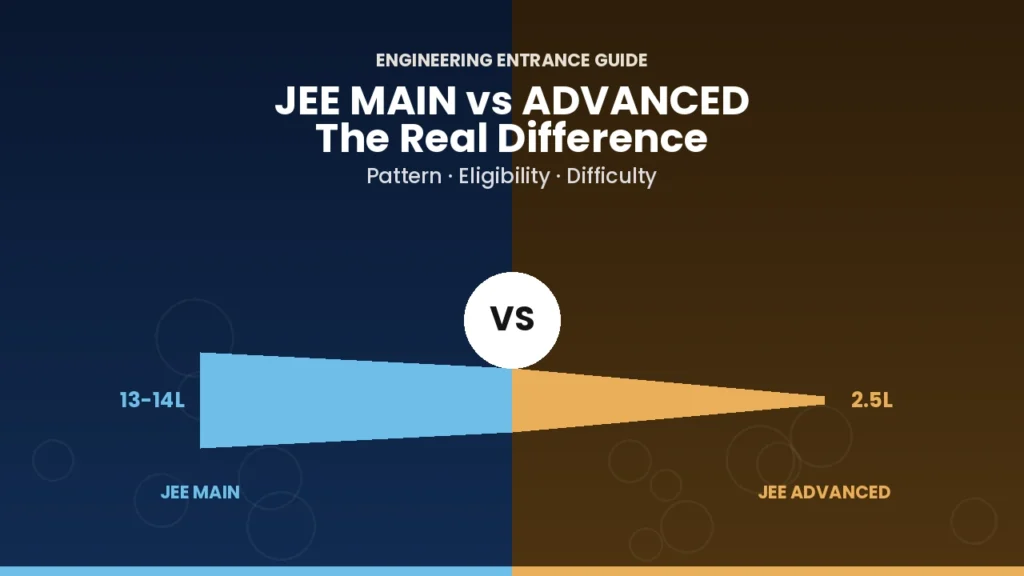
JEE Main and JEE Advanced serve genuinely different purposes despite both falling under the broader Joint Entrance Examination umbrella. JEE Main is the qualifying exam that opens admission to NITs, IIITs, and other government-funded technical institutes, and it also acts as the screening round for JEE Advanced, which is the exclusive gateway to the IITs. JEE Main follows a fixed, predictable pattern with 75 questions across Physics, Chemistry, and Mathematics and a standard marking scheme of plus 4 for a correct answer and minus 1 for an incorrect one, while JEE Advanced uses two compulsory three-hour papers with a marking scheme that changes every year, including partial marking and multiple-correct-answer questions designed specifically to test deeper conceptual understanding rather than memorized formulas. Roughly 13 to 14 lakh students appear for JEE Main each year, but only the top 2.5 lakh qualify to attempt JEE Advanced, making it a significantly smaller, more competitive pool by design.
Confusing JEE Main and JEE Advanced, or assuming that clearing one is functionally the same as being ready for the other, is one of the most common miscalculations engineering aspirants make. This guide breaks down exactly how these two exams differ in purpose, pattern, eligibility, and difficulty, so your preparation targets the right exam at the right time.
Purpose: What Each Exam Actually Leads To
Understanding the fundamental purpose behind each exam clears up most of the confusion around how to prepare for them.
- JEE Main is the primary qualifying exam for admission to NITs, IIITs, and other Government Funded Technical Institutes, and every engineering aspirant in India who wants an IIT seat must clear it first, since it also functions as the screening stage for JEE Advanced.
- JEE Advanced exists exclusively to determine admission into the IITs, and strong performance here can also open doors to closely linked premier institutions like IISc and the IISERs through their own separate admission channels.
- Because JEE Main serves double duty, as both a standalone qualifying exam and a gateway exam, it’s genuinely possible to secure a strong NIT or IIIT seat through JEE Main alone without ever needing to sit for JEE Advanced.
Eligibility Differences
Eligibility criteria diverge sharply between the two exams, and this is where many students first realize how much more selective JEE Advanced actually is.
- JEE Main is open to any candidate who has passed or is currently appearing in Class 12, with a comparatively wide window of academic years accepted and no strict age bar tied to birth year.
- JEE Advanced eligibility is far tighter. Only candidates who rank among the top 2.5 lakh in JEE Main qualify to appear, and general category candidates must meet a specific birth-year cutoff, with a 5-year age relaxation extended to SC, ST, and PwD candidates.
- JEE Main allows multiple attempts across sessions within an academic year, along with a wider choice of exam languages, while JEE Advanced permits only two attempts across two consecutive years, making each attempt considerably higher stakes.
Comparing Exam Pattern and Marking Scheme
The structural differences between the two papers are substantial, and they directly shape how each exam should be prepared for.
| Aspect | JEE Main | JEE Advanced |
|---|---|---|
| Exam Mode | Computer-based test | Computer-based test |
| Number of Papers | Paper 1 (B.E./B.Tech) has one paper | Two compulsory papers, Paper 1 and Paper 2 |
| Duration | Set duration for Paper 1 | 3 hours per paper, 6 hours total |
| Question Pattern | Fixed pattern, consistent every year | Pattern changes every year by design |
| Number of Questions | 75 questions (25 each in Physics, Chemistry, Mathematics) | Varies each year |
| Marking Scheme | +4 for correct MCQ, -1 for incorrect | Complex, varies by question type, includes partial marking |
| Negative Marking | Applies to MCQs; numerical-type marking rules vary by year | Applies selectively, differs by section and question type |
| Question Types | Primarily MCQs and numerical value questions | MCQs, multiple-correct MCQs, numerical, matrix-match, comprehension-based |
The unpredictability built into JEE Advanced’s pattern is a deliberate choice by the IITs, intended to test genuine adaptability and conceptual depth rather than rewarding students who’ve simply memorized a fixed question format.
Why JEE Advanced Feels Genuinely Harder
Both exams draw from the same broad Physics, Chemistry, and Mathematics syllabus at the Class 11 and 12 level, but the way concepts get tested differs meaningfully.
- JEE Main questions tend to test whether you know a concept and can apply it in a fairly standard, expected way.
- JEE Advanced questions frequently approach the same underlying concept from an unfamiliar angle, rewarding students who genuinely understand the reasoning behind a method rather than those who’ve only memorized the standard approach to a problem type.
- Multiple-correct MCQs in JEE Advanced, where more than one option can be correct and partial marking applies, add a layer of strategic decision-making that JEE Main’s simpler marking scheme doesn’t require.
- A small number of topics appear in one exam’s syllabus but not the other, so students preparing only for JEE Main can reasonably deprioritize certain advanced-only topics, though this should always be confirmed against the latest official syllabus for the specific year.
How to Structure Your Preparation for Both
Since JEE Main is a mandatory stepping stone toward JEE Advanced, most serious aspirants prepare for both simultaneously rather than treating them as separate tracks.
- Build your core conceptual foundation first, since both exams draw from the same underlying syllabus and a strong foundation genuinely supports both.
- Practice standard, fixed-pattern questions for JEE Main readiness, focusing on speed and accuracy given its consistent format and higher volume of questions relative to time.
- Deliberately practice unfamiliar, application-based problems for JEE Advanced readiness, since its unpredictable pattern rewards comfort with unusual question framing rather than pattern recognition alone.
- Take JEE Advanced’s variable marking scheme seriously during practice, working through past papers that reflect partial marking and multiple-correct formats so exam-day strategy doesn’t have to be figured out for the first time under pressure.
- Treat the gap between JEE Main and JEE Advanced as a distinct preparation phase, since qualifying candidates typically get a short but genuinely important window to specifically sharpen advanced-level problem-solving before the second exam.
Frequently Asked Questions
Q. What is the main difference between JEE Main and JEE Advanced?
A. JEE Main is the qualifying exam for NIT, IIIT, and GFTI admissions and also screens candidates for JEE Advanced, while JEE Advanced is the exclusive exam required for admission to the IITs, with a smaller, more competitive candidate pool and a deliberately unpredictable question pattern.
Q. Do I need to clear JEE Main to appear for JEE Advanced?
A. Yes. Only candidates ranking among the top 2.5 lakh in JEE Main are eligible to appear for JEE Advanced, making JEE Main a mandatory qualifying step before JEE Advanced.
Q. Is JEE Advanced harder than JEE Main?
A. Yes, generally. JEE Advanced tests deeper conceptual application through an unpredictable pattern that changes every year, including multiple-correct MCQs and partial marking, while JEE Main follows a fixed, more predictable format focused on standard application of concepts.
Final Thoughts
JEE Main and JEE Advanced are connected but fundamentally different exams, one built for broad, predictable qualification into NITs and IIITs, the other built as a deliberately unpredictable filter for IIT admission that rewards genuine conceptual depth over memorized patterns. Understanding these differences in purpose, eligibility, pattern, and marking scheme should directly shape how you prepare, building strong fundamentals that serve both exams, then layering in exam-specific practice, speed and accuracy for JEE Main, adaptability and strategic marking awareness for JEE Advanced, as your preparation matures. Approached this way, the transition from clearing JEE Main to genuinely competing in JEE Advanced becomes a planned progression rather than an unexpected jump in difficulty.