
Best Way to Revise NCERT Quickly: A Complete Guide
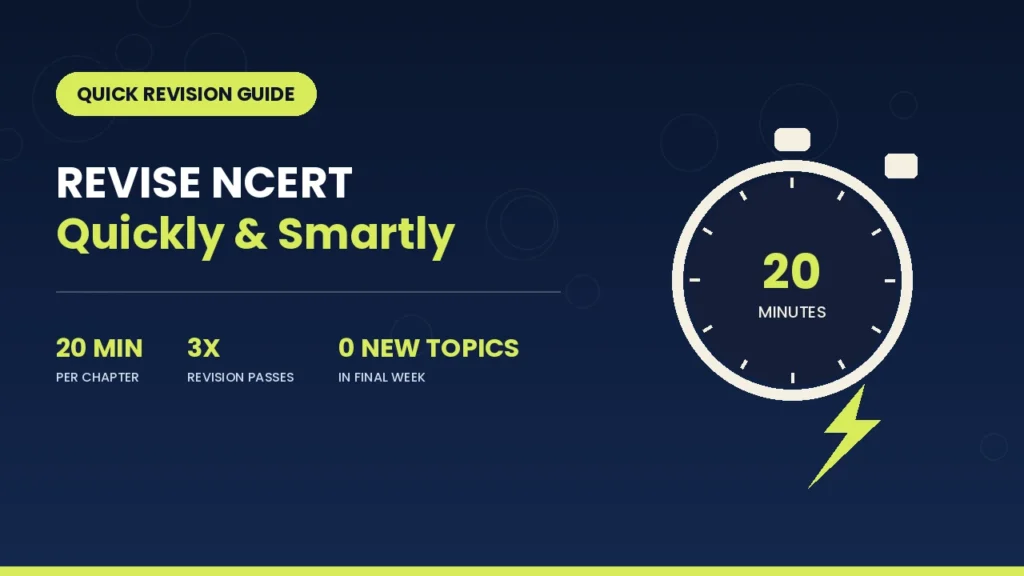
The fastest effective way to revise NCERT is the 20-minute chapter method: spend the first 5 minutes scanning headings and bold terms, the next 10 minutes reviewing diagrams, definitions, and in-text questions, and the final 5 minutes recalling the chapter from memory without looking at the book. This compresses a full chapter review into a single focused session rather than a multi-hour re-read. For genuinely last-minute revision, in the final one to two weeks before an exam, the priority order should be NCERT line-by-line for Biology and high-weightage Science and Social Science chapters, formula sheets and named reactions for Physics and Chemistry, and previous year questions solved in timed sets rather than casual reading. Toppers across NEET, JEE, and CBSE consistently report doing three layered revision passes before an exam rather than one long read-through, and they avoid starting any new topic in the final week, since unfamiliar material at that stage adds risk without adding meaningful score.
Revising NCERT quickly isn’t about reading faster, it’s about reading differently, with a structure that prioritizes recall and high-yield content over passive, chapter-by-chapter re-reading. This guide breaks down exactly how to compress NCERT revision into focused, effective sessions, whether you have a month left or just a few final days.
Why Re-Reading NCERT Slowly Doesn’t Work Under Time Pressure
Before getting into specific techniques, it’s worth understanding why the instinct to simply “read it all again” tends to fail when time is genuinely limited.
- Passive re-reading creates familiarity without testing actual recall, which means you feel prepared without necessarily being able to retrieve the information under exam conditions.
- A full, careful first-time read of an NCERT chapter and a revision pass should look completely different, revision needs to move faster and focus only on what you’re likely to forget, not what you already understand well.
- Without a clear method, revision time tends to get spent unevenly, with too much time on comfortable chapters and too little on genuinely weak ones.
- Quick revision, done properly, still needs structure. Speed without structure just becomes skimming, which builds false confidence rather than genuine readiness.
The 20-Minute Chapter Revision Method
This single technique scales to almost any subject and is specifically built for speed without sacrificing genuine recall.
- Minutes 1-5: Scan the chapter’s headings, subheadings, and bold or highlighted terms to reload the chapter’s overall structure in your mind.
- Minutes 6-15: Review diagrams, definitions, formulas, and in-text questions specifically, since these are the elements NCERT-based exams draw from most directly.
- Minutes 16-20: Close the book and try to recall the chapter’s key points from memory, writing them down or reciting them aloud, then check what you missed.
Applied consistently, this method lets you revise an entire subject’s worth of chapters in a single day or two, which is genuinely difficult to achieve through traditional slow re-reading.
Building a Layered Revision Schedule
Toppers across competitive exams consistently describe doing multiple revision passes rather than one long read-through, and this layered approach applies just as well to board exam preparation.
| Revision Pass | Timing | Objective | Approach |
|---|---|---|---|
| First pass | 3-4 weeks before exam | Full syllabus coverage | Quick refresh of concepts, key points, and diagrams without deep re-study |
| Second pass | 1-2 weeks before exam | Target weak areas | Focus on forgotten topics, mock test mistakes, and difficult concepts specifically |
| Third pass | Final 2-3 days | Consolidation and confidence | Short notes, formula sheets, and NCERT diagrams only, no new material |
- Each pass should be faster than the one before it, since your familiarity with the material naturally increases with each round.
- The second pass is where an error log becomes genuinely valuable, since it directs your limited time toward what you’ve actually gotten wrong before, rather than everything equally.
- The final pass should feel calm and light, focused purely on reinforcing what you already know rather than cramming anything new.
Subject-Specific Quick Revision Techniques
Different subjects reward different revision shortcuts, and applying the same method uniformly across all of them wastes time.
- Biology and Life Sciences: Revise directly from NCERT rather than guide books, focusing specifically on diagrams, tables, and definitions, since a large share of exam questions are built directly around these elements.
- Physics and Chemistry: Consolidate formulas, named reactions, and standard derivations onto a single reference sheet, and revise that sheet repeatedly rather than flipping through full chapters again.
- Mathematics: Focus revision on formulas, theorems, and standard question patterns rather than reading theory, then solve 10 to 15 problems at a time from previous year or sample papers to keep both recall and calculation speed sharp.
- Social Science and History: Use timelines, cause-and-effect charts, and short structured notes rather than re-reading full paragraphs, since these subjects respond well to visual, organized summaries.
- Across every subject, mnemonics and acronyms genuinely help with long factual lists, since converting a list into a short, memorable phrase makes recall considerably faster under exam pressure than trying to remember the list in its original form.
Using Flashcards and Short Notes Effectively
Flashcards and short notes are specifically built for rapid review, but only when they’re built correctly.
- Write a clear question or prompt on one side and a concise answer on the other, keeping each card focused on a single fact, formula, or concept rather than an entire topic.
- Review flashcards during small pockets of time, such as short breaks or just before sleeping, rather than treating them as a separate long study session.
- Keep short notes genuinely short. A one-page summary per chapter, covering only definitions, formulas, and key diagrams, is far more useful during rapid revision than detailed notes that essentially recreate the textbook.
- Rebuild or trim your notes periodically through your preparation, since notes that keep growing eventually become just as time-consuming to review as the original textbook.
What to Avoid During Quick Revision
A few habits genuinely undermine fast, effective NCERT revision, and avoiding them matters as much as using the right techniques.
- Starting new topics in the final week. Unfamiliar material at this stage adds risk and anxiety without meaningfully improving your score, compared to strengthening what you already know.
- Passive highlighting without active recall. Highlighting feels productive but doesn’t test whether you can actually retrieve the information without the book in front of you.
- Long, uninterrupted study marathons. Short, frequent revision sessions consistently outperform exhausting, hours-long sessions, since fatigue sharply reduces retention regardless of how much material you cover.
- Skipping previous year questions in favor of only re-reading. Solving timed question sets reveals genuine gaps that passive review simply doesn’t surface.
- Disrupting your sleep schedule for extra revision time. A tired, under-slept mind retains and recalls information considerably worse than a well-rested one, making late-night cramming a poor trade-off close to exam day.
Frequently Asked Questions
Q. What is the fastest way to revise an NCERT chapter?
A. The 20-minute method works well: spend 5 minutes scanning headings and key terms, 10 minutes reviewing diagrams and definitions, and the final 5 minutes recalling the chapter from memory without looking at the book.
Q. How many times should I revise NCERT before an exam?
A. Most toppers recommend at least three layered revision passes, a broad first pass weeks before the exam, a focused second pass targeting weak areas about one to two weeks out, and a light, consolidating final pass in the last two to three days.
Q. Should I start new topics during last-minute revision?
A. No. Starting new topics in the final week adds risk without meaningfully improving your score. It’s more effective to strengthen and revise material you’ve already studied rather than learning something unfamiliar under time pressure.
Final Thoughts
Revising NCERT quickly comes down to structure, not speed alone. The 20-minute chapter method, a layered revision schedule with progressively faster passes, subject-specific shortcuts like formula sheets and diagram-focused review, and well-built flashcards together let you cover an entire syllabus efficiently without falling into the trap of passive, time-consuming re-reading. Avoid starting new material late, protect your sleep, and prioritize active recall over familiarity, and your final days of NCERT revision will build genuine, exam-ready confidence rather than just the feeling of having studied.