
How to Study NCERT Books Effectively: A Complete Guide
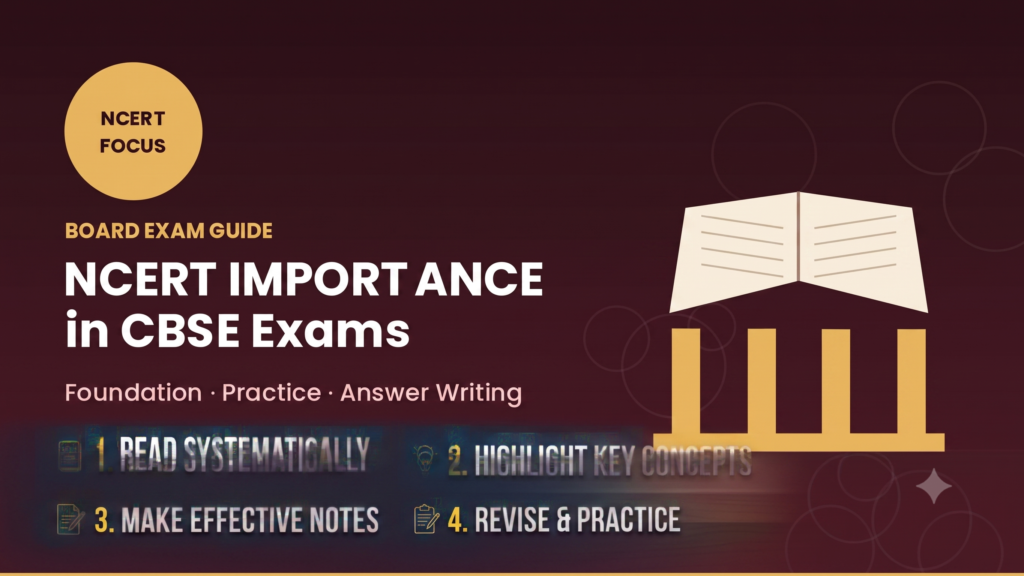
Almost every student preparing for CBSE board exams, and a huge number preparing for competitive exams like NEET, JEE, and UPSC, gets told the same advice at some point: read NCERT thoroughly. The advice is genuinely sound, but it comes with a problem rarely addressed alongside it, most students aren’t actually told how to study these books in a way that leads to genuine retention rather than passive familiarity. Reading a chapter once, highlighting a few lines, and moving on feels productive in the moment, but it rarely translates into the kind of recall you need when facing an actual exam question weeks or months later.
This guide walks through exactly how to study NCERT books effectively, covering active reading techniques, note-making that actually helps rather than just duplicates the text, and revision strategies backed by how memory genuinely works, rather than habits that simply feel productive without delivering results.
Why Passive Reading Doesn’t Work
Before getting into specific techniques, it’s worth understanding why the most common approach, reading a chapter start to finish and perhaps highlighting a few sentences, tends to produce weaker results than students expect. Passive reading creates a feeling of familiarity with the material, your brain recognizes the words and ideas as you encounter them again, which can feel like understanding. But recognition and genuine recall are different cognitive processes entirely, and exams almost always demand recall, the ability to retrieve information without it being placed in front of you, rather than mere recognition.
This gap between feeling prepared and actually being prepared is one of the most common reasons students who’ve genuinely put in reading hours still struggle when facing an exam paper. The fix isn’t reading more, it’s reading differently, in a way that actively tests and reinforces memory rather than passively reinforcing familiarity.
The First Read: Building Initial Understanding
Your first pass through any NCERT chapter should focus purely on building a general understanding of what the chapter covers, without getting bogged down trying to memorize every detail immediately. Read through the chapter at a comfortable pace, paying attention to headings, subheadings, and how the chapter is structured overall, since this structure itself often mirrors how the concepts logically build on each other.
During this first read, resist the urge to highlight extensively or take detailed notes. Instead, simply note down, mentally or with a light mark, any sections that feel particularly complex or unclear, since these are the areas you’ll want to return to with extra attention during your second, deeper pass through the material.
The Second Read: Active Engagement and Note-Making
This is where the real work of studying happens, and it looks quite different from simply reading again. On your second pass, engage actively with the text by asking yourself questions as you go. What’s the main idea of this section? How does this connect to what I already know from earlier chapters or other subjects? Could this be tested as a numerical problem, a short answer, or a diagram-based question?
This is also the stage to build genuine notes, but done correctly rather than simply copying sentences from the textbook. Effective notes summarize ideas in your own words rather than transcribing the book’s exact phrasing, since the act of rephrasing forces your brain to actually process and understand the material rather than mechanically copying it. Keep these notes concise, focused on key facts, definitions, formulas, and the logical connections between ideas, rather than lengthy paragraphs that essentially recreate the textbook in a slightly shorter form.
For subjects like History and Geography, building a simple timeline or a structured list of key events and their causes and effects genuinely helps organize information that might otherwise feel like a jumble of disconnected facts. For Science subjects, redraw diagrams by hand rather than only looking at them, since the physical act of drawing and labeling reinforces spatial memory in a way that passive viewing simply doesn’t. For Mathematics, work through in-text and exercise problems yourself before checking solutions, since attempting a problem independently, even if you get it wrong initially, builds far stronger understanding than reading a worked solution passively.
Using Active Recall as Your Core Study Technique
Active recall is genuinely one of the most well-supported memory techniques available, and it’s remarkably simple to apply to NCERT study. After reading and taking notes on a section, close the book and try to write down or recite everything you remember without looking back at the text. This deliberate struggle to retrieve information, rather than simply re-reading it, is precisely what strengthens memory retention over time.
| Study Technique | What It Involves | Why It Works |
|---|---|---|
| Active Recall | Closing the book and recalling information from memory before checking notes | Forces genuine retrieval rather than passive recognition, strengthening long-term memory |
| Spaced Repetition | Revisiting the same material at increasing intervals, such as after one day, three days, then a week | Reinforces memory at the point it would otherwise start fading, making retention more durable |
| Self-Quizzing | Creating questions from your own notes and testing yourself regularly | Simulates exam conditions and reveals gaps before the actual exam does |
| Concept Mapping | Building visual diagrams connecting related ideas across a chapter or subject | Helps organize scattered facts into a coherent structure that’s easier to recall as a whole |
| Teaching Explanation | Explaining a concept aloud as though teaching someone else | Reveals genuine gaps in understanding, since unclear explanations point to unclear grasp of the concept |
Combining active recall with spaced repetition specifically has strong backing as an effective memory strategy, and applying both consistently to NCERT study, rather than relying purely on re-reading, tends to produce noticeably stronger retention over the same amount of total study time.
Building a Spaced Repetition Schedule
Spaced repetition works because memory naturally fades over time unless it’s reinforced at the right intervals, and reinforcing it too early or too late wastes the benefit. A practical approach for NCERT study involves revisiting a chapter’s key points roughly one day after your initial study session, then again after three days, then again after about a week, and periodically after that as your exam approaches.
This doesn’t need to be a lengthy process each time. A focused ten to fifteen minute review of your notes and a quick self-recall exercise, done at these intervals, reinforces retention far more effectively than a single long re-reading session close to your exam date. Building this into your regular study schedule, rather than treating revision as an afterthought squeezed in during the final weeks, makes an enormous difference to how much you genuinely retain by exam day.
Studying NCERT Differently Across Subjects
While the core techniques above apply broadly, different subjects benefit from some specific adjustments worth keeping in mind.
For Science subjects, particularly Physics, Chemistry, and Biology, pay close attention to diagrams and practice reproducing them from memory, since these frequently appear directly in exams and rushed, unpracticed sketches often lose marks for missing or mislabeled parts. Build separate flashcards or quick-reference notes for formulas and definitions specifically, since these benefit enormously from repeated, spaced quizzing rather than being buried within longer notes.
For Mathematics, active recall looks slightly different, it means attempting problems from memory rather than just reciting facts. Work through NCERT exercises multiple times across your preparation period, spacing out your repeat attempts rather than solving every question once and moving on permanently.
For History, Geography, Political Science, and Economics, building structured summaries organized around cause-and-effect relationships, chronological sequences, or conceptual categories helps enormously, since these subjects often involve more interconnected facts than isolated definitions, and a good structure makes recall considerably easier than a flat list of unconnected points.
Common Mistakes That Undermine NCERT Study
A handful of patterns show up repeatedly among students who put in genuine hours but see limited results, and recognizing them can help redirect that effort more productively.
Highlighting extensively without actually testing recall afterward creates a false sense of familiarity that doesn’t hold up under actual exam conditions, since highlighting itself is a passive activity that doesn’t require genuine retrieval. Relying solely on re-reading chapters multiple times, rather than incorporating active recall and spaced repetition, tends to produce diminishing returns, since re-reading familiar material rarely strengthens memory as effectively as attempting to recall it independently. Copying entire paragraphs into notes rather than summarizing in your own words essentially recreates the textbook without adding the cognitive processing that genuine understanding requires. Cramming revision into the final days before an exam, rather than spacing it consistently throughout your preparation period, leaves memory considerably weaker than a well-spaced revision schedule would have produced with the same total study time.
Final Thoughts
Studying NCERT books effectively isn’t about reading them more times or highlighting more sentences, it’s about engaging actively with the material through structured note-making in your own words, testing your memory deliberately through active recall, and reinforcing that memory through spaced repetition rather than last-minute cramming. These techniques demand a bit more discipline than simply reading passively, but they consistently produce far stronger retention for the same amount of study time invested. Build these habits into your regular study routine from early in your preparation, rather than treating them as exam-week tactics, and NCERT study becomes a genuinely reliable foundation for whichever exam, school or competitive, you’re ultimately preparing for.