
Physical Test Requirements for NDA/CDS: A Complete Guide
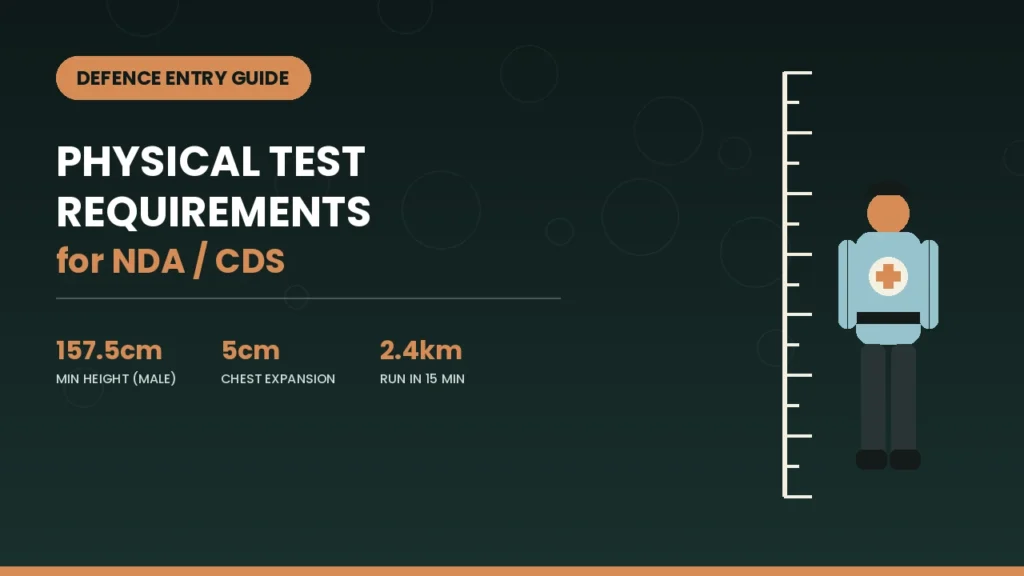
Physical and medical fitness for NDA and CDS is assessed after the SSB interview, through a Service Medical Board examination that takes three to five days at a military hospital, and it applies uniformly regardless of how well a candidate performed in the written exam or interview. The minimum height requirement is 157.5 cm for male candidates applying to Army and Navy wings, 162.5 cm for Air Force, and 152 cm for female candidates, with relaxations of up to 5 cm for candidates from Gorkha, Garhwal, Kumaon, and North Eastern hill regions, and 2 cm for candidates from Lakshadweep. Chest expansion must measure at least 5 cm after full inspiration, vision standards require at least 6/6 in one eye and 6/9 in the other for most roles, with stricter, uncorrected standards for Air Force candidates, and hearing must register a forced whisper from 610 cm away. Reports indicate SSB boards reject a significant share of otherwise recommended candidates purely on medical grounds, making physical preparation just as decisive as academic and interview preparation.
Many NDA and CDS aspirants pour months into written exam preparation and SSB readiness, only to discover the medical board can undo all of it in a single afternoon. This guide breaks down exactly what the physical and medical standards for NDA and CDS actually involve, so nothing catches you off guard at the final stage.
Where the Medical Test Fits in the Selection Process
Understanding the sequence matters, since the physical and medical evaluation happens after, not alongside, your written exam and interview.
- The full selection process runs through three stages: the written exam, the five-day SSB interview, and finally the medical board.
- The medical examination is conducted at designated military hospitals by a board of military doctors, following standards prescribed in the Indian Army Medical Standards.
- Even a candidate fully recommended by the SSB can still be rejected at this stage if they fail to meet prescribed medical criteria, making it a genuinely independent hurdle rather than a formality.
- If declared unfit at the initial medical board, candidates can request a review medical at a higher board, though there’s no guarantee of a different outcome, which is why walking in prepared matters far more than hoping to appeal afterward.
Height and Weight Standards
Height requirements form the first, most basic filter in the medical evaluation, and they differ by wing and gender.
| Category | Minimum Height Requirement |
|---|---|
| Male (Army/Navy) | 157.5 cm |
| Male (Air Force) | 162.5 cm |
| Female (all wings) | 152 cm |
| Gorkha, Garhwal, Kumaon, North Eastern hill candidates | Up to 5 cm relaxation |
| Candidates from Lakshadweep | Up to 2 cm relaxation |
- Weight must be proportionate to height and age, assessed against official height-weight charts used by the UPSC and Military Nursing Service, rather than judged against a single fixed number.
- Simply crossing the minimum height threshold isn’t sufficient on its own. Body proportions, including weight distribution, chest development, and posture, are all assessed together as part of overall service suitability.
- Candidates should always cross-check the latest UPSC notification and service-specific medical rules for their target wing rather than relying on generalized figures alone, since standards can be refined between recruitment cycles.
Chest and Physical Development Standards
Chest measurement standards specifically evaluate lung capacity and overall physical development, both directly relevant to sustained physical performance during training.
- The chest should be well developed, with a fully expanded measurement generally expected to be no less than 81 cm.
- Minimum chest expansion after full inspiration must be at least 5 cm, measured with a tape positioned so its lower edge touches the nipple line in front and the upper part touches the lower angle of the shoulder blades behind.
- Candidates should have no congenital or functional abnormalities of the bones or joints, and no history of fractures or dislocations that could compromise physical performance.
- Conditions like knock knees, flat feet, or spinal issues such as scoliosis are specifically checked during the orthopedic examination and can result in rejection if present.
Vision and Hearing Standards
Vision standards are particularly strict, and requirements vary depending on which service wing a candidate is applying to.
- Most candidates need a minimum of 6/6 vision in one eye and 6/9 in the other to clear the standard requirement.
- Air Force candidates face notably stricter conditions, since spectacles are not permitted during selection, and LASIK or other corrective eye surgery is generally not allowed for this specific wing.
- Candidates must also pass a Color Vision Test conducted to the CP-1 standard, particularly critical for roles involving navigation and technical operations.
- Candidates who have undergone LASIK surgery may still be eligible for non-Air Force wings, provided their resulting visual acuity meets the specified standard, though this should always be confirmed against current medical guidelines before the procedure, not after.
- Hearing standards require candidates to detect a forced whisper from a distance of 610 cm, roughly 20 feet, in a quiet testing environment.
- Dental standards require a minimum of 14 sound dental points, checked as part of the broader medical examination.
The Physical Fitness Test Component
Beyond the static medical measurements, candidates are also expected to demonstrate functional fitness through specific physical tasks.
- Running: Candidates are generally expected to cover 2.4 km within roughly 15 minutes, though training toward completing it closer to 12 minutes builds a genuine safety margin.
- Push-ups: A minimum of around 20 repetitions is commonly expected.
- Sit-ups: A minimum of around 20 repetitions is commonly expected.
- Chin-ups: A minimum of around 8 repetitions is commonly expected.
- Rope climbing: Candidates are typically expected to climb approximately 3.4 meters using both hands and feet.
- While SSB itself doesn’t include a separately scored fitness test, physical stamina and composure are continuously observed throughout outdoor group tasks over the five-day process, meaning fitness indirectly shapes your overall SSB impression as well.
Common Reasons Candidates Get Medically Rejected
A number of medical rejections are genuinely preventable with earlier attention, rather than being fixed, unavoidable outcomes.
- Obesity or weight disproportionate to height, which is entirely addressable through sustained training well before the medical board date.
- Flat foot or untreated old injuries, both of which sometimes go unnoticed by candidates until the formal orthopedic examination flags them.
- Uncorrected vision issues, particularly relevant for Air Force aspirants given the stricter no-spectacles, no-surgery policy.
- Dental issues below the minimum sound-teeth threshold, often overlooked simply because candidates don’t think to get a dental check before their medical board date.
How to Prepare Your Body Alongside Your Academics
Physical readiness isn’t something to address only after receiving an SSB recommendation, since by then there’s little time left to correct deeper issues.
- Begin structured, progressive physical training well in advance, covering running, strength basics, and flexibility, rather than attempting a rushed final-weeks fitness push.
- Get a basic health check, including vision and dental screening, early in your preparation timeline so any correctable issues can be addressed with enough lead time.
- Build fitness into a daily habit rather than an occasional activity, since sustained physical readiness matters more for both SSB performance and the eventual medical board than short bursts of intense effort close to your exam date.
- Always verify current standards directly against the official NDA or CDS notification for your specific entry and wing, since exact figures can be refined between recruitment cycles.
Frequently Asked Questions
Q. What is the minimum height for NDA?
A. The minimum height for NDA is 157.5 cm for male candidates applying to Army and Navy wings, 162.5 cm for Air Force, and 152 cm for female candidates, with relaxations available for candidates from specific hill regions and Lakshadweep.
Q. Can I wear glasses for NDA medical test?
A. Candidates applying for Army and Navy wings can generally wear spectacles if their corrected vision meets the required standard, but Air Force candidates are not permitted to wear spectacles during selection, and LASIK surgery is also generally not allowed for this wing specifically.
Q. Does SSB include a physical fitness test?
A. SSB itself does not include a separately scored fitness test, but physical stamina is continuously observed during outdoor group tasks. The formal physical and medical evaluation, including height, weight, chest expansion, vision, and functional fitness assessment, happens separately at the Service Medical Board after SSB recommendation.
Final Thoughts
Physical and medical fitness for NDA and CDS is every bit as decisive as the written exam and SSB interview, and it’s assessed independently at a Service Medical Board that can reject even a fully recommended candidate. Meeting height, chest expansion, vision, and hearing standards, alongside functional fitness benchmarks in running, push-ups, and sit-ups, requires sustained preparation well before your medical board date, not a rushed effort after SSB results. Address correctable issues like weight, vision, and dental health early, verify current standards against the official notification for your specific wing, and treat physical readiness as a parallel priority alongside academics from the very start of your preparation.