State Board vs CBSE: Which Is Better?
This question comes up in almost every Indian home with a school-going child. State Board or CBSE? Both have real strengths. Both come with real trade-offs. The right answer depends more on your child and your family’s plans. It depends less on which board simply sounds more prestigious.
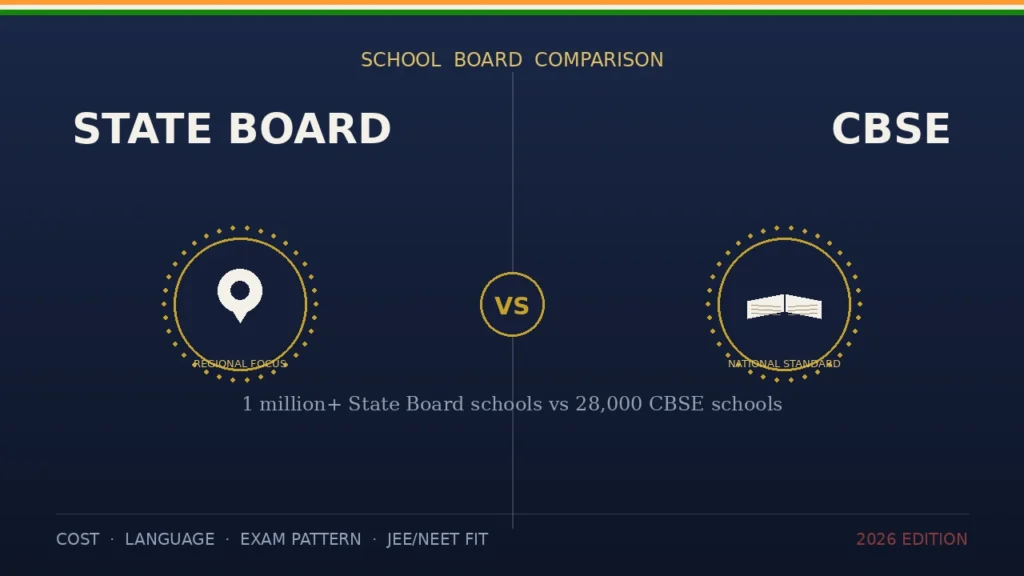
India has over 1.5 million schools today. Only about 28,000 follow CBSE. The rest, the vast majority, follow one state board or another. So state boards aren’t some small, regional afterthought. They educate most of the country. But CBSE still holds a clear edge in specific cases. This shows up most around national exams and frequent moves between states.
This guide lays out the real differences. It includes a full comparison table. This way, you can choose based on facts, not assumptions.
The Core Difference: Who Sets the Syllabus
CBSE stands for Central Board of Secondary Education. One national body designs its syllabus. Every CBSE school follows the same NCERT based books, no matter which state it sits in. This builds real consistency. A student can move from a CBSE school in Delhi to one in Kerala. The syllabus barely shifts.
State boards work differently. Each state runs its own board. Each has its own textbooks and its own syllabus. Maharashtra has its SSC board. Karnataka has its own. Tamil Nadu, West Bengal, and every other state follow this same pattern. These boards often include local history, regional language content, and state-specific context. Each one is built around that region’s own needs.
State Board vs CBSE: Full Comparison Table
| Parameter | CBSE | State Board |
|---|---|---|
| Governing body | One national body, the Central Board of Secondary Education | A separate board for each state, run by the state government |
| Number of schools | Around 28,000 across India | Well over a million, the majority of Indian schools |
| Curriculum style | Uniform nationwide, NCERT based | Varies by state, often includes regional and local content |
| Medium of instruction | Mostly English, some Hindi medium schools too | Regional language options are common, alongside English medium schools |
| Fee range | Often higher, especially in private urban schools | Wide range, from free government schools to mid-range private ones |
| Exam pattern in 2026 | Two attempts for Class 10, one annual exam for Class 12 | Mostly one annual exam, varies a little by state |
| Competitive exam alignment | Strong, since NCERT content maps closely to JEE, NEET, and CUET | Moderate, some bridging often needed for national entrance exams |
| Ease of switching schools | Easier across states, since the syllabus stays consistent | Harder across states, since syllabus and language can differ sharply |
| Best suited for | Families that relocate often, or students targeting national exams | Families settling long term in one state, or students targeting state-level exams and jobs |
| Regional relevance | Lower, content stays broadly national in scope | Higher, content often reflects local history, culture, and language |
Keep in mind that individual schools vary a lot within both systems. A well run state board school can easily outperform a mediocre CBSE school. The reverse holds true too.
Why CBSE Often Wins for Competitive Exams
This is CBSE’s clearest edge. National entrance exams like JEE, NEET, and CUET are built directly around NCERT textbooks. CBSE already teaches from these same books. So a CBSE student’s daily coursework overlaps heavily with what these exams test. This saves real time during entrance exam prep. Students aren’t learning a whole separate syllabus on the side.
State board students can crack these same exams too. Many toppers each year come from state board backgrounds. But they often need extra bridging material. This helps them match the exact question style and depth these national exams expect. Their regular coursework simply doesn’t map onto NCERT content as closely.
Why State Boards Still Matter, A Lot
State boards carry real strengths. These often get overlooked in this debate. Regional language instruction helps many students grasp ideas faster. This holds true especially in early years. Learning in your first language builds a stronger base. Local context helps too. History and geography lessons feel more real and grounded this way.
Cost is another real factor. State boards include many government and aided schools. This makes quality education more accessible across income levels. Not every family can afford the higher fees at private CBSE schools, especially in cities.
Some students plan to stay and build a career in their home state. For them, state boards often fit better. They connect well with state-level government exams. They also connect well with local university seats and regional job markets.
The 2026 Exam Pattern Difference
CBSE brought in a real change this year. Class 10 students can now sit for their board exam twice. Once in February, and again in May. The higher score counts. Class 12 still runs on one annual exam.
Most state boards have not picked up this two-exam system for 2026. They still run one annual exam per level. But several states are slowly shifting their papers too. They’re moving toward more competency-based, application-focused formats. This follows the same broad direction set by NEP 2020.
How NEP 2020 Is Changing Both Systems
The National Education Policy of 2020 has reshaped both CBSE and most state boards. The pace of change still differs a lot, though. Both systems now push toward skill-based subjects. Both push toward project work too, and away from rote memorization. CBSE has moved a bit faster here. It already has new skill electives in place. It already uses heavier competency-based question formats. Many state boards are following this same path. But the rollout speed varies by state.
This shift matters either way. Pure memorization is becoming a weak strategy under both systems. Real, applied understanding is now what sets top scorers apart.
Making the Right Choice for Your Family
There’s no single correct answer here. Accept that early on. A few honest questions can guide you better than any general ranking.
Does your family move often, across states, for work? If so, CBSE helps. Its consistency makes these moves far less disruptive for your child’s schooling.
Is your child likely to sit for JEE, NEET, or another major national entrance exam? CBSE’s tight NCERT alignment gives a genuine head start. But it’s not the only path to success in these exams.
Do you plan to settle long term in one state? Will your child likely study or work locally later? A strong state board school can serve that path just as well. Often, this comes at a lower cost too, with regional language support and local context built in.
Above all, look closely at the specific school. Don’t focus on the board name alone. Teaching quality matters more. So does faculty experience. So does the overall learning space. These shape a child’s outcome far more than any board name.
Final Thoughts
State Board and CBSE both lead to strong outcomes. This holds true as long as the school itself is solid. CBSE offers national consistency. It gives a real edge for competitive exam prep. This suits families who move often. It also suits students aiming at JEE, NEET, or similar exams. State boards offer regional relevance. They often cost less too. And they lead to strong outcomes for students planning a more local path.
Don’t chase board reputation alone. Visit the schools you’re considering. Talk to current parents and teachers. Match your choice to your child’s real learning style. Match it to your family’s actual life plans too, not just to whichever board seems to carry more prestige on paper.