
How to Crack SSC in First Attempt: A Complete Guide
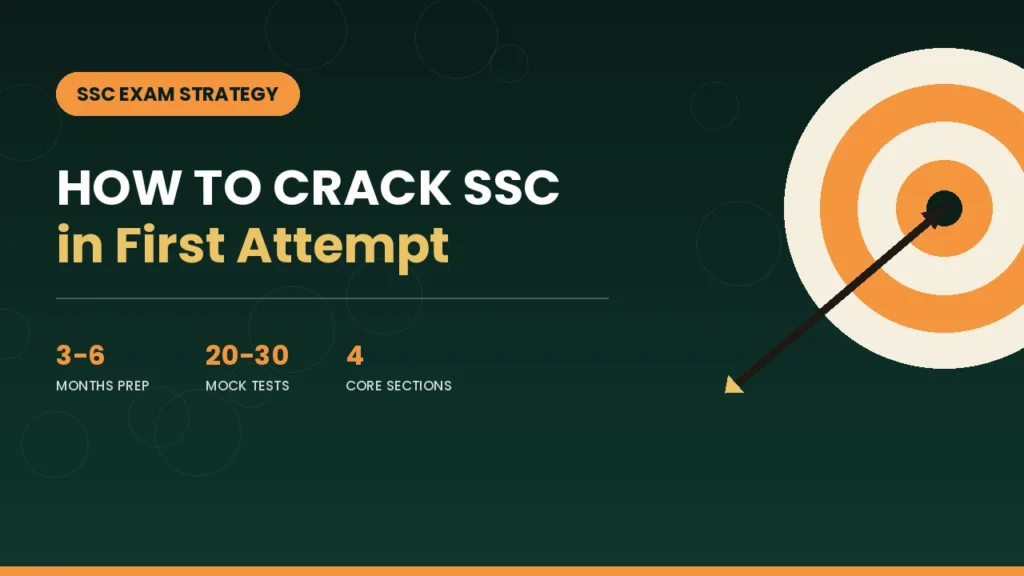
Cracking SSC exams like CGL or CHSL in your first attempt is genuinely achievable within three to six months of focused preparation, provided you prioritize the four core sections correctly: Quantitative Aptitude and Reasoning for daily practice, English through consistent reading, and General Awareness through a small daily habit rather than last-minute cramming. First-attempt success depends less on total study hours and more on solving previous year papers early, taking regular timed mock tests from month two onward, and mastering the elimination technique given SSC’s negative marking penalty of a quarter to a third of a mark per wrong answer depending on the exam. Candidates who clear SSC on their first try typically report starting with a clear syllabus breakdown, tracking weak areas through an error log, and attempting at least twenty to thirty full-length mock tests before the actual exam.
Every SSC exam cycle draws lakhs of first-time applicants, and the difference between those who clear it on attempt one and those who need two or three more cycles usually isn’t raw ability, it’s whether their preparation was structured around what the exam actually rewards. This guide breaks down exactly how to approach SSC preparation as a first-time aspirant, so your initial attempt genuinely counts.
Why First Attempts Often Go Wrong
Understanding the common failure points among first-time SSC aspirants helps you avoid repeating them.
- Starting preparation without reading the actual syllabus and exam pattern in detail, leading to scattered effort across topics that carry little weightage while neglecting high-yield areas.
- Treating all four sections equally, when Quantitative Aptitude and Reasoning typically offer the highest score-to-effort ratio with consistent daily practice.
- Delaying mock tests until the final month, leaving no time to build genuine speed and time management under real exam pressure.
- Ignoring General Awareness because it feels unpredictable, when a small, consistent daily habit can make it one of the more reliably scoreable sections over several months.
- Guessing randomly on uncertain questions, without accounting for SSC’s negative marking, which quietly erodes scores that otherwise looked strong on paper.
Building Your First-Attempt Study Plan
A structured plan matters more for first-time aspirants than for repeat candidates, since you don’t yet have prior exam experience to fall back on.
- Weeks 1-2: Syllabus mapping. Go through the complete official syllabus and previous year papers for your specific SSC exam, noting which topics appear most frequently across recent years.
- Months 1-2: Foundation building. Work through core concepts in Quantitative Aptitude and Reasoning systematically, while starting a daily newspaper reading habit for English and General Awareness in parallel.
- Months 2-3: Practice and application. Shift toward solving previous year questions section-wise, and begin sectional mock tests to identify where your accuracy genuinely stands.
- Final month: Full mock tests and revision. Attempt full-length, timed mock tests at least twice a week, review every mistake in detail, and revise formulas, vocabulary, and current affairs notes rather than learning new material this late.
Section-Wise Strategy for First-Time Aspirants
| Section | First-Attempt Priority | Practical Approach |
|---|---|---|
| Quantitative Aptitude | High | Daily practice sets, focus on speed after concepts are clear |
| Reasoning | High | Daily practice, since patterns are learnable and highly scoreable |
| English Language | Medium-High | Daily reading, grammar revision, comprehension practice |
| General Awareness | Medium | Small daily current affairs habit, periodic static GK revision |
| Mock Tests | Critical from month 2 onward | Section-wise first, then full-length under timed conditions |
Mastering Negative Marking Before Exam Day
This single factor separates confident first-attempt clears from candidates who underperform despite solid preparation.
- SSC exams typically deduct a fraction of a mark, often a quarter or a third depending on the specific exam, for every incorrect answer.
- Use the elimination technique deliberately: attempt a question only if you can confidently rule out at least two of the four options.
- If you have genuinely no basis for narrowing down an answer, skip it rather than guessing randomly, since unfounded guesses tend to hurt more than they help across a full paper.
- Practice this exact decision-making process during mock tests, not for the first time on the actual exam day, so it becomes instinctive rather than a stressful in-the-moment calculation.
Making Mock Tests Your Core Practice Tool
For a first attempt specifically, mock tests serve a purpose beyond just practice, they build genuine familiarity with exam-day pressure that nothing else replicates.
- Start with section-wise mock tests once you’ve covered a reasonable portion of your syllabus, rather than waiting until you feel fully prepared.
- Progress to full-length, timed mock tests by your second month of preparation, simulating the actual exam’s time limits strictly.
- After every mock test, maintain an error log noting whether each mistake came from a conceptual gap, a careless error, or poor time allocation, then revisit that log weekly.
- Aim to complete at least twenty to thirty full-length mock tests before your actual exam, since this volume is what genuinely builds the speed and composure first-time aspirants often lack.
Common First-Attempt Mistakes to Avoid
A few patterns show up repeatedly among candidates who don’t clear SSC on their first try, and they’re worth naming directly.
- Collecting too many books and resources without finishing any single one thoroughly, leaving preparation broad but shallow.
- Neglecting previous year papers in favor of generic practice questions that don’t reflect SSC’s actual question style and difficulty.
- Studying only during “ideal” long stretches and skipping days when time feels short, rather than protecting a smaller, consistent daily block.
- Panicking during the actual exam and abandoning a practiced strategy, such as attempting questions out of order or second-guessing timed pacing built up through mock tests.
Frequently Asked Questions
Q. How many months are enough to crack SSC on the first attempt?
A. Three to six months of focused, structured preparation is generally sufficient for most first-time aspirants, provided the time is used for consistent daily practice across all four sections rather than concentrated in short, intense bursts.
Q. Is coaching necessary to crack SSC in the first attempt?
A. No. SSC exams draw heavily on school-level concepts and previous year question patterns, both genuinely accessible through self-study, previous year papers, and disciplined mock test practice.
Q. What is the biggest mistake first-time SSC aspirants make?
A. Delaying timed mock test practice until the final weeks is one of the most common and costly mistakes, since it leaves little room to build the speed and negative-marking strategy that SSC’s time-pressured format genuinely demands.
Final Thoughts
Cracking SSC on your first attempt comes down to structured preparation rather than sheer luck or raw talent: mapping the syllabus early, prioritizing Quantitative Aptitude and Reasoning for daily practice, building a consistent General Awareness habit, and treating mock tests as central to your routine from month two onward rather than a final-week formality. Master the elimination technique well before exam day, keep an honest error log, and avoid the common first-attempt pitfalls of scattered resources and delayed practice. Approached this way, a first attempt stops being a trial run and becomes a genuinely well-prepared shot at clearing the exam outright.