
Railway Job Eligibility Criteria: A Complete Guide
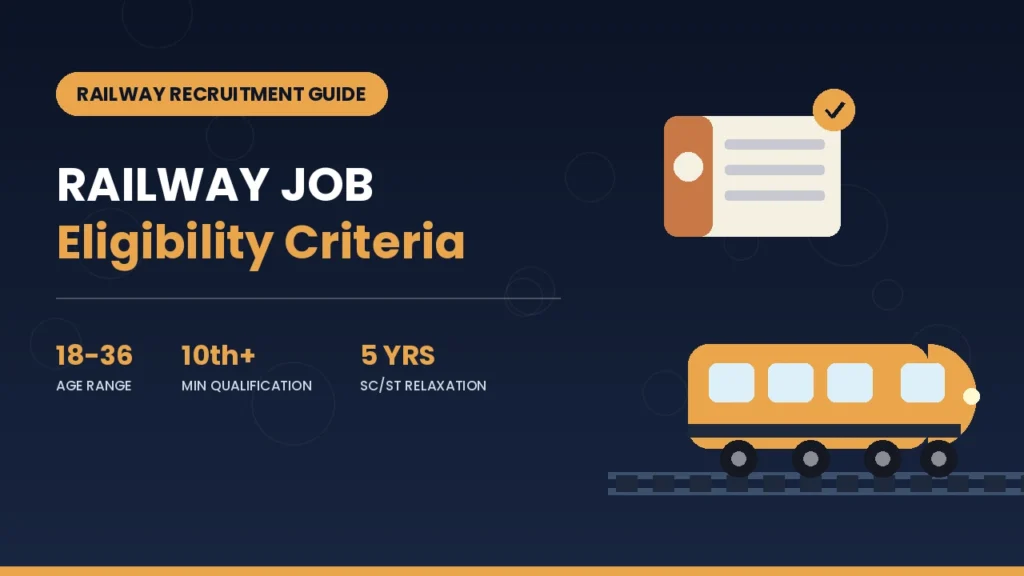
Railway job eligibility in India depends primarily on three factors: age, educational qualification, and nationality, with specific requirements varying by post. The minimum age for nearly every railway post is 18 years, while the upper age limit generally ranges from 30 to 33 years for most technical and non-technical posts, and up to 36 years for select graduate-level NTPC positions, with reserved category candidates getting additional age relaxation of 3 to 15 years depending on their category. Educational requirements scale directly with post level: Class 10 pass for Group D non-technical roles, Class 10 plus an ITI certificate for Group D technical roles and Assistant Loco Pilot, Class 12 pass for NTPC undergraduate posts like Junior Clerk, and a graduation degree for NTPC graduate posts like Station Master and Junior Engineer roles. All applicants must be Indian citizens, though certain subjects of Nepal, Bhutan, and specific categories of Tibetan refugees and persons of Indian origin from designated countries are also eligible under government-specified conditions.
Railway Recruitment Boards reject a meaningful number of applications every cycle simply because candidates didn’t check eligibility carefully before applying. This guide breaks down exactly what age, education, and other requirements apply across the major railway recruitment categories, so you can confirm eligibility before investing months into preparation.
Age Limit Requirements by Post Category
Age eligibility is the first filter every railway application goes through, and it varies meaningfully depending on which specific post you’re targeting.
- RRB Group D posts, covering roles like Track Maintainer and Helper, generally require candidates to be between 18 and 33 years of age, though exact limits are confirmed in each specific notification.
- Assistant Loco Pilot and Technician posts typically require an age range of 18 to 30 years, given the more physically demanding, safety-critical nature of these roles.
- RRB NTPC Undergraduate posts, such as Junior Clerk and Accounts Clerk, generally require candidates to be between 18 and 33 years old.
- RRB NTPC Graduate posts, such as Station Master and Senior Time Keeper, typically extend the upper age limit further, generally up to 36 years, since these roles expect candidates who’ve already completed a full degree.
- RRB Junior Engineer posts, being technical roles requiring a diploma or degree, generally follow an age range similar to NTPC graduate posts.
Age Relaxation for Reserved Categories
Age relaxation exists specifically to widen access for candidates from historically underrepresented groups, and it applies on top of the standard upper age limit for each post.
- OBC (Non-Creamy Layer) candidates typically receive a relaxation of 3 years beyond the standard upper age limit.
- SC and ST candidates typically receive a relaxation of 5 years beyond the standard upper age limit.
- Persons with Disabilities generally receive more substantial relaxation, often ranging from 10 to 15 years depending on category overlap.
- Ex-servicemen are entitled to specific relaxation as per government norms, calculated based on their length of military service.
Exact relaxation figures can shift slightly between notification cycles, so always cross-check the specific relaxation table published in your target exam’s official notification rather than relying on general figures alone.
Educational Qualification by Post Level
Educational requirements for railway jobs follow a fairly clear tiered structure, scaling directly with the seniority and technical demand of the post.
| Qualification Level | Applicable Posts | Typical Stream Requirement |
|---|---|---|
| Class 10 Pass | Group D (Track Maintainer, Helper, Porter) | Any stream |
| Class 10 + ITI Certificate | Group D Technical roles, Assistant Loco Pilot, Technician | ITI in relevant trade, NCVT/SCVT approved |
| Class 12 Pass | RRB NTPC Undergraduate posts (Junior Clerk, Accounts Clerk) | Any stream, minimum aggregate as specified |
| Diploma in Engineering | Junior Engineer (select posts) | Relevant engineering discipline |
| Graduation Degree | RRB NTPC Graduate posts (Station Master, Senior Time Keeper), RRB JE | Any stream for NTPC, relevant engineering degree for JE |
This structure means a single RRB recruitment drive can span candidates from a bare Class 10 pass up to full graduates, all applying under the same broader RRB umbrella but for genuinely different posts within it.
Nationality and Citizenship Requirements
Every railway job in India requires confirmed citizenship status, verified carefully during the document verification stage of recruitment.
- Applicants must be citizens of India to be eligible for railway recruitment.
- Subjects of Nepal and Bhutan are also eligible under specific government provisions.
- Tibetan refugees who came to India before a government-specified cutoff date, with the clear intention of permanently settling in India, are eligible under defined conditions.
- Persons of Indian origin who have migrated from Pakistan, Burma, Sri Lanka, and certain East African countries with the intention of permanently settling in India are eligible, subject to a formal eligibility certificate issued by the Government of India.
- Candidates falling under any category beyond straightforward Indian citizenship must generally produce a certificate of eligibility, which needs to be secured before applying, not obtained afterward.
Medical Fitness and Physical Standards
Beyond age, education, and nationality, railway jobs also carry medical fitness requirements that vary by post, since roles involve different physical and visual demands.
- Visual acuity standards are particularly strict for roles like Assistant Loco Pilot, Station Master, and other safety-critical positions, given the direct responsibility these roles carry for train operations.
- Group D posts generally involve physical fitness tests alongside broader medical fitness checks, since these roles often demand sustained physical activity.
- Medical standards are typically categorized into different classes depending on the post, with technical and safety-critical roles subject to the strictest visual and physical requirements.
- Candidates should get a basic health and vision check done well before applying, so any correctable issues can be addressed in time rather than discovered late in the recruitment process.
How to Verify Your Specific Eligibility
Given how much these requirements vary by post and shift slightly between recruitment cycles, verification directly through official sources matters considerably.
- Always check the specific, currently active notification for your target post on the official RRB regional website, rather than relying on generic eligibility summaries from unofficial sources.
- Pay close attention to the exact cutoff date used to calculate your age, since this reference date changes with each notification and directly determines whether you fall within the eligible range.
- Confirm your educational qualification matches the exact requirement listed, since some posts specify a particular subject combination or ITI trade rather than just a general qualification level.
- If you belong to a reserved category or claim any age relaxation, keep the relevant certificates ready and verified in advance, since document verification stages reject applications where claimed relaxation isn’t properly substantiated.
Frequently Asked Questions
Q. What is the minimum qualification for a railway job?
A. The minimum qualification for railway jobs is a Class 10 pass, required for Group D non-technical posts like Track Maintainer and Helper. Technical Group D posts and Assistant Loco Pilot additionally require an ITI certificate.
Q. What is the age limit for RRB Group D?
A. RRB Group D generally requires candidates to be between 18 and 33 years of age, though the exact range is confirmed in each specific recruitment notification and reserved category candidates receive additional age relaxation.
Q. Is graduation required for all railway jobs?
A. No. Graduation is required only for specific NTPC Graduate posts like Station Master and Senior Time Keeper, and for Junior Engineer roles requiring a relevant engineering degree or diploma. Many railway posts, including Group D and NTPC Undergraduate posts, require only a Class 10 or Class 12 pass.
Final Thoughts
Railway job eligibility in India follows a clear, tiered structure across age, education, nationality, and medical fitness, but the exact figures genuinely vary by post and by recruitment cycle, making direct verification through official RRB notifications essential rather than optional. Confirm your age falls within the specified range for your target post, including any reserved category relaxation you’re entitled to, match your educational qualification precisely against the post’s stated requirement, and address any medical or visual fitness concerns well before applying. Getting this groundwork right before you begin preparation ensures the months you invest in studying actually lead toward a post you’re genuinely eligible for.