
ICSE Exam Preparation Tips: A Complete Guide
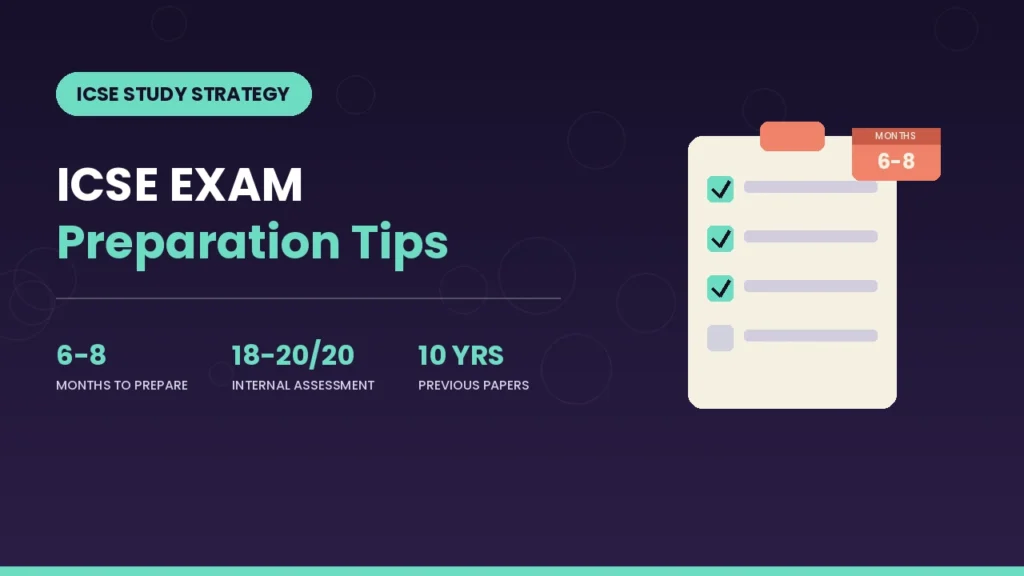
Scoring well in ICSE board exams depends on understanding the board’s specific 80:20 external-to-internal marking structure, mastering the prescribed textbooks such as Selina for Science and ML Aggarwal or Concise for Mathematics, and practicing at least eight to ten years of previous papers, since ICSE questions follow a genuinely predictable pattern year after year. Students aiming to score above 90 percent typically begin structured preparation six to eight months before the exam, dividing study time across major subjects daily while dedicating one full day each week purely to revision. Internal assessment, worth 20 out of every 100 marks in most subjects, deserves the same seriousness as the written paper, with a realistic target of 18 to 20 out of 20. Since ICSE calculates the final result from a student’s best five subjects including English, identifying and strengthening your genuinely strongest subjects early in the year can meaningfully shape your overall percentage.
ICSE has a reputation for being one of the more demanding Indian school boards, largely because of how heavily it weighs written expression and detailed, structured answers over quick objective recall. That reputation is manageable once you understand exactly what the exam rewards. This guide breaks down practical, subject-wise preparation strategies for ICSE, along with the study habits that consistently separate high scorers from the rest.
Understanding the ICSE Exam Structure First
Before building any study plan, it helps to be clear on exactly how ICSE grades your performance, since this shapes where your effort should go.
- Every ICSE subject typically follows an 80:20 split, with 80 marks from the external written board exam and 20 marks from internal assessment conducted by your school throughout the year.
- English is compulsory and is tested across two separate papers, Paper 1 covering Language, including composition, letter writing, comprehension, and grammar, and Paper 2 covering Literature, including prescribed drama, poetry, and prose.
- Science subjects, Physics, Chemistry, and Biology, are each examined as separate 80-mark papers with their own internal assessment component.
- History and Civics is typically assessed through one combined paper.
- The minimum passing requirement is 35 percent, and your final result is calculated using your best five subjects, with English compulsorily included among them.
Building a Realistic Study Timeline
Students aiming for a genuinely strong result, above 90 percent specifically, generally benefit from starting focused, structured preparation six to eight months ahead of the exam rather than compressing everything into the final weeks.
- Divide daily study time across your major subjects, Mathematics, Science, and English, while still allocating consistent time to Social Science and your second language rather than neglecting them until later.
- Set aside one full day every week dedicated purely to revising previously covered chapters, since this single habit does more to prevent last-minute cramming than almost anything else.
- Avoid studying one subject continuously for extended hours. Alternating between subjects within a study day helps maintain concentration and prevents the fatigue that comes from prolonged focus on a single area.
- Take regular practice tests throughout your preparation period, not just close to the exam, since these reveal your actual weak areas early enough to genuinely address them.
Subject-Wise Preparation Strategy
Different ICSE subjects reward different preparation approaches, and treating every subject identically tends to waste study time that could be better targeted.
- Mathematics: Master your prescribed textbook, commonly ML Aggarwal or Concise Mathematics, thoroughly rather than skipping around. Keep a dedicated notebook specifically for formulas and a separate one for practicing sums regularly, and focus extra attention on chapters you consistently find difficult rather than only revisiting ones you’re already comfortable with.
- Science: Selina remains the standard prescribed textbook across Physics, Chemistry, and Biology, and since ICSE draws heavily from textbook content, working through every in-text and end-of-chapter question matters considerably. Neat, correctly labeled diagrams carry real marks in Science answers, so practice drawing them by hand rather than only reviewing them passively.
- English: Treat Paper 1 and Paper 2 as genuinely different skill sets. For Language, practice composition and letter writing regularly, aiming for at least two full compositions a week, alongside consistent grammar drills and daily unseen passage practice to build reading speed. For Literature, go beyond simple summaries into genuine character analysis and thematic understanding of your prescribed texts, since ICSE literature questions frequently test interpretation rather than plain recall.
- History, Civics, and Geography: Build concise notes organized around cause-and-effect relationships and chronological sequences for History and Civics. For Geography specifically, practice map work and diagrams daily, since these carry significant, easily securable marks that many students underprepare for.
Comparing Subject-Specific Preparation Priorities
| Subject | Prescribed Textbook | Core Preparation Focus |
|---|---|---|
| Mathematics | ML Aggarwal / Concise Mathematics | Formula notebook, consistent practice on weak chapters |
| Physics, Chemistry, Biology | Selina | Textbook mastery, neat labeled diagrams |
| English Paper 1 (Language) | Prescribed language textbook | Composition, letter writing, grammar, unseen passages |
| English Paper 2 (Literature) | Prescribed literature texts | Character analysis, theme understanding |
| History & Civics | Prescribed textbook | Structured notes, cause-and-effect understanding |
| Geography | Prescribed textbook | Daily map work and diagram practice |
Exact textbook editions and syllabus emphasis can be refined between academic years, so always confirm you’re working from the current syllabus and prescribed edition for your specific year.
Making the Most of Internal Assessment
Internal assessment is worth 20 out of every 100 marks in most ICSE subjects, and treating it as a minor formality compared to the written exam is a genuine, avoidable mistake.
- Aim realistically for 18 to 20 out of 20 in every subject’s internal assessment, since this component is entirely within your control through consistent, quality classwork and project submission throughout the year.
- For Science subjects, this typically involves practical work and lab-based assessment, so consistent engagement during practical sessions matters as much as your written exam preparation.
- For English specifically, internal assessment evaluates speaking and listening skills, so practicing reading aloud, listening to structured English content, and recording your own speech for pronunciation feedback genuinely helps.
- Since these marks accumulate throughout the academic year rather than on a single exam day, staying consistent with classwork and projects from the very start pays off considerably more than trying to catch up later.
Using Previous Year Papers Effectively
ICSE’s question patterns tend to repeat in structure and style far more predictably than many students expect, which makes previous year papers an unusually high-value resource.
- Work through as many as eight to ten years of previous papers per subject, since ICSE’s question framing style remains fairly consistent across years.
- Solve full papers under timed conditions rather than casually browsing through them, since building comfort with the actual time pressure matters as much as knowing the content.
- After each paper, review carefully where marks were lost, whether from incomplete answers, weak presentation, or genuine conceptual gaps, and adjust your revision accordingly.
- Download the latest official sample papers directly from the board’s own resources for the most accurate reflection of current question style, rather than relying solely on older, unofficial compilations.
Frequently Asked Questions
Q. How many months are needed to prepare well for ICSE Class 10 exams?
A. Students aiming for a strong result, particularly above 90 percent, generally benefit from six to eight months of structured, consistent preparation rather than concentrated last-minute effort.
Q. Is internal assessment important in ICSE?
A. Yes. Internal assessment contributes 20 out of every 100 marks in most subjects, and students should aim for 18 to 20 out of 20, since this component is built through consistent classwork and practical work across the year rather than a single exam.
Q. Which textbooks should ICSE students focus on?
A. Selina remains the standard textbook for Physics, Chemistry, and Biology, while ML Aggarwal or Concise Mathematics are the most commonly used textbooks for Mathematics. Mastering these prescribed textbooks thoroughly matters more than collecting additional unofficial guides.
Final Thoughts
Strong ICSE performance comes down to understanding the board’s specific structure, mastering your prescribed textbooks like Selina and ML Aggarwal rather than skipping straight to guide books, and practicing consistently with several years of previous papers under timed conditions. Give internal assessment genuine, sustained attention throughout the year rather than treating it as secondary to the written exam, and build a study rhythm that alternates subjects and includes weekly revision rather than last-minute cramming. Approached this way, ICSE’s demanding reputation becomes a matter of disciplined, well-structured preparation rather than an insurmountable challenge.