
NEET Rank vs College Analysis: A Complete Guide
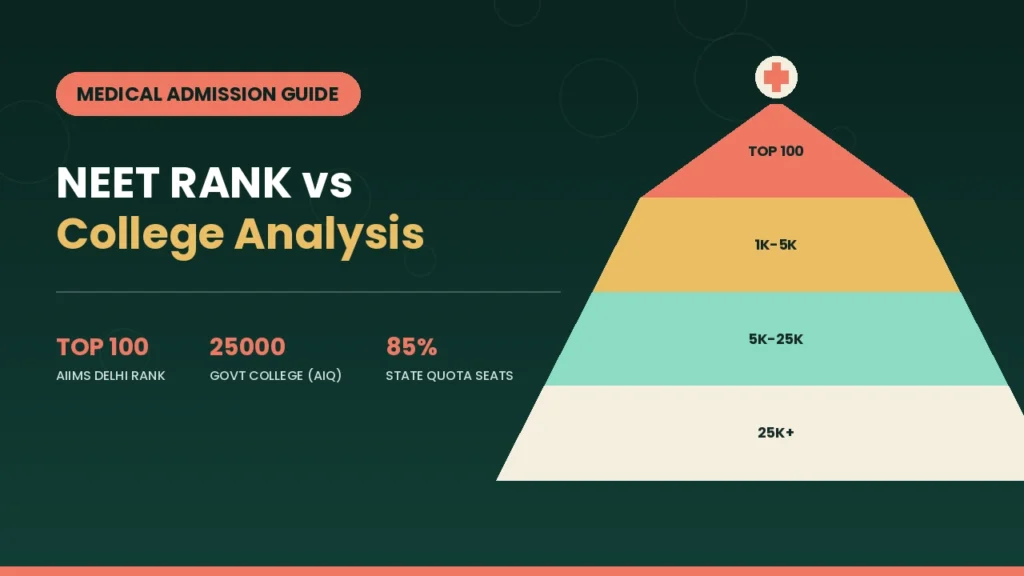
NEET rank requirements vary dramatically by college tier, quota type, and category, but historical admission patterns offer a reliable general guide. AIIMS Delhi has consistently closed within the top 50 to 100 ranks for the General category, other established AIIMS campuses like Jodhpur and Bhopal typically close between rank 200 and 1,000, and JIPMER Puducherry has historically closed around the top 200. Beyond this top tier, strong state government medical colleges and newer AIIMS campuses generally admit General category candidates within the 1,000 to 8,000 rank range, while a much broader set of government medical colleges across states become genuinely accessible anywhere from rank 8,000 up to 50,000 or higher depending on the state’s seat matrix. Government MBBS seats fill through two separate channels, the 15% All India Quota counselled by the MCC and the 85% State Quota counselled by individual states, and cutoffs for the same college can differ substantially between these two routes.
Every year, thousands of NEET aspirants discover only during counselling that their rank doesn’t align with the mental picture of colleges they’d been aiming for throughout their preparation. Understanding roughly where different rank bands actually land, before results are out, helps you set realistic targets and build sensible backup options. This guide breaks down how NEET rank maps to college tiers, why the same rank can mean different things depending on quota and category, and how to plan around this analysis sensibly.
Why “What Rank Gets What College” Doesn’t Have One Fixed Answer
Before looking at rank bands, it’s worth understanding why this question resists a single, fixed answer, since cutoffs shift meaningfully from year to year.
- Cutoffs depend on exam difficulty each year, the total number of candidates, and the specific seat matrix available, meaning a rank that secured a particular college one year might not secure the same college the next.
- Category-wise reservation, General, OBC, EWS, SC, and ST, means the same numerical rank effectively represents different levels of competitiveness depending on which category a candidate falls under.
- Quota type matters enormously. All India Quota seats, comprising 15% of government MBBS seats, are counselled centrally by the Medical Counselling Committee, while the remaining 85% State Quota seats are counselled separately by each state, often with meaningfully different, and sometimes considerably more accessible, cutoffs for domicile students.
- Because of this, treating any single rank number as a fixed guarantee for a specific college is genuinely misleading. What follows are historical patterns, not promises, and should be checked against the current year’s actual counselling data once available.
General Rank Bands and What They Have Historically Meant
Based on how admissions have played out across recent NEET cycles, rank bands tend to cluster into a few broad tiers for General category candidates under the All India Quota.
| Rank Range (General, AIQ) | Typical College Tier |
|---|---|
| Top 50-100 | AIIMS Delhi, the most competitive medical seat in the country |
| 100-1,000 | Other established AIIMS campuses (Jodhpur, Bhopal), JIPMER, top state government colleges like Maulana Azad Medical College |
| 1,000-5,000 | Newer AIIMS campuses, strong state government medical colleges in major cities |
| 5,000-25,000 | Broader range of government medical colleges across states, still through AIQ |
| 25,000-50,000+ | Increasingly dependent on state quota rather than AIQ, newer or regional government colleges |
| 50,000 and beyond | Private medical colleges, deemed universities, or state quota seats in states with less competitive cutoffs |
These figures reflect general historical tendencies rather than a guarantee for any specific year, and category-wise cutoffs for OBC, EWS, SC, and ST candidates are typically less steep, meaning candidates in these categories have historically secured similar-tier colleges at comparatively higher numerical ranks.
Why State Quota Often Tells a Different Story
The 85% State Quota portion of government MBBS seats frequently paints a considerably more optimistic picture than All India Quota figures alone suggest.
- State quota cutoffs are calculated separately by each state based on domicile-only competition, which is a smaller pool than the national AIQ pool.
- A rank that wouldn’t secure a particular government college through AIQ can sometimes secure the same or a comparable college through state quota, provided the candidate holds domicile status in that state.
- States with fewer medical colleges relative to their population, or with historically lower application volumes, tend to show noticeably more accessible state quota cutoffs than larger, more competitive states.
- Always check both AIQ and your specific state’s quota cutoff trends separately, since relying on AIQ figures alone can make your realistic options look narrower than they actually are.
Building a Realistic College List Based on Your Rank
Rather than fixating on a single dream college, a smarter approach uses your rank, once known, to build a realistic, tiered list of options.
- Plan backwards from your target college, not forward from the qualifying cutoff. Simply clearing NEET’s minimum qualifying mark, generally around the 50th percentile, is a completely different bar from securing an actual MBBS seat, which requires a considerably higher admission cutoff.
- List colleges across at least three tiers: a stretch tier reflecting your most ambitious target, a realistic tier matching your rank’s historical pattern, and a safety tier you’d genuinely be comfortable accepting.
- Check both AIQ and your home state’s quota cutoffs separately for every college on your list, since the same college can appear at very different rank levels depending on which route you’re counselled through.
- Keep BDS, AYUSH courses, or veterinary science as backup options if your rank falls below the range needed for MBBS seats you’re targeting, since these fields draw from the same NEET score and offer genuine, respected career paths of their own.
- Revisit your list after each counselling round, since seat matrices and cutoffs shift between rounds as candidates confirm, withdraw, or upgrade their allotted seats.
Common Mistakes in Rank-to-College Planning
A handful of avoidable mistakes show up repeatedly among NEET candidates during counselling season.
- Assuming a rank that secured a particular college in a previous year will automatically do the same this year, without accounting for shifts in exam difficulty and candidate volume.
- Relying only on All India Quota cutoff data while ignoring potentially more favorable state quota options available through domicile status.
- Fixating exclusively on AIIMS or a handful of famous names while overlooking genuinely strong state government medical colleges that offer excellent clinical training at a considerably more accessible rank range.
- Waiting until the final counselling round to research backup options, rather than building a realistic tiered list from the moment results are declared.
Frequently Asked Questions
Q. What NEET rank is needed for AIIMS Delhi?
A. Historically, AIIMS Delhi has closed within the top 50 to 100 ranks for General category candidates under the All India Quota, making it the single most competitive medical seat in the country.
Q. What is a good NEET rank for a government medical college?
A. A rank within the top 25,000 for General category candidates has historically offered a reasonably strong chance at some government medical college through All India Quota, though state quota often extends genuine possibilities considerably further for candidates with domicile status in less competitive states.
Q. Is State Quota cutoff different from All India Quota cutoff?
A. Yes. State Quota cutoffs are calculated separately based on domicile-only competition within each state, and can be meaningfully more accessible than All India Quota cutoffs for the same or a comparable college, depending on the specific state.
Final Thoughts
NEET rank-to-college mapping follows recognizable historical patterns, AIIMS Delhi at the very top, other AIIMS campuses and JIPMER close behind, and a widening range of government medical colleges becoming accessible as rank numbers increase, but none of these figures should be treated as fixed guarantees given how much cutoffs shift year to year based on difficulty and competition. Build a realistic, tiered college list once your actual rank is known, check both All India Quota and your specific state’s quota cutoffs separately, and keep genuine backup options in mind rather than fixating on a single dream college. Approached this way, NEET counselling becomes a structured, informed decision process rather than an anxious guessing game.