
CLAT vs AILET: A Complete Guide
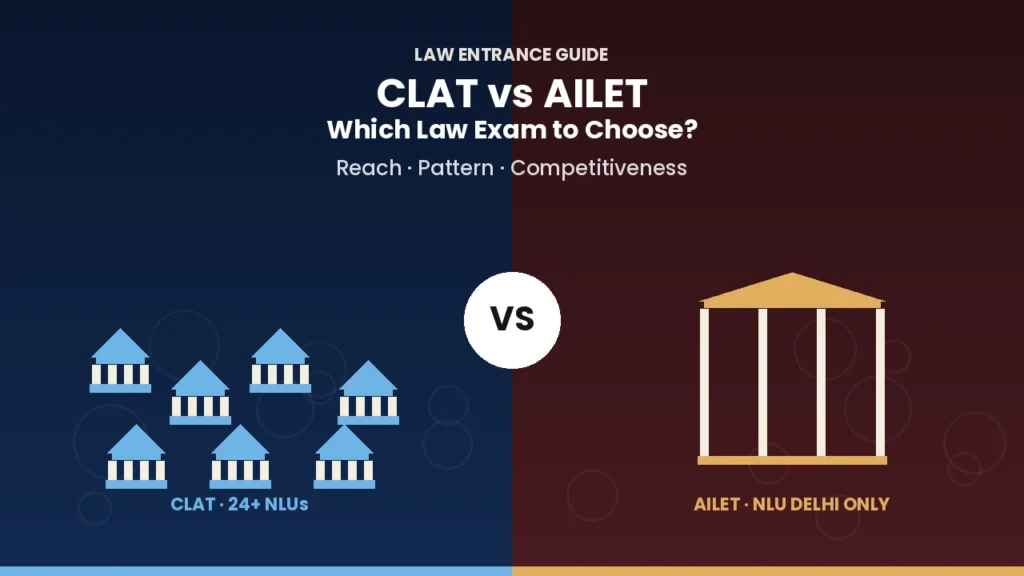
CLAT and AILET are both national-level law entrance exams, but they differ fundamentally in reach and structure. CLAT, conducted by the Consortium of National Law Universities, is accepted by over two dozen NLUs across India, including NLSIU Bangalore, NALSAR Hyderabad, and WBNUJS Kolkata, along with several private law colleges, offering roughly 4,000 undergraduate seats across all participating universities combined. AILET, conducted solely by NLU Delhi, grants admission to just one institution, making it considerably more competitive on a per-seat basis despite drawing a smaller overall applicant pool. CLAT tests five sections, English, Current Affairs and GK, Legal Reasoning, Logical Reasoning, and Quantitative Techniques, through a predominantly passage-based format, while AILET skips a separate Quantitative Techniques section entirely and weights Logical Reasoning heavily, often accounting for close to half the total marks. Since AILET is typically held about a week after CLAT and the syllabus overlaps substantially, most serious law aspirants prepare for and appear at both exams rather than choosing only one.
Choosing between CLAT and AILET isn’t really an either-or decision for most students, since the two exams complement each other more than they compete. This guide breaks down exactly how CLAT and AILET differ in structure, syllabus, and competitiveness, so you understand what each one demands and why appearing for both is usually the smarter strategy.
What Each Exam Is Actually For
Before comparing specifics, it’s worth understanding the core structural difference between how these two exams are governed and what they lead to.
- CLAT is conducted by the Consortium of National Law Universities, a collective body formed by member institutions that jointly decide the syllabus, pattern, and admission criteria each year, meaning any change to CLAT’s format affects every participating NLU at once.
- AILET is conducted independently by NLU Delhi alone, giving the university full control over its own question paper, evaluation process, and counselling, entirely separate from the Consortium’s decisions.
- CLAT scores open the door to a genuinely wide network of NLUs, so a single exam and application can lead to multiple possible outcomes depending on your rank.
- AILET is a single-institution exam. A strong AILET score gets you into NLU Delhi specifically, and there’s no fallback within the exam itself if that particular seat doesn’t work out.
- NLU Meghalaya sits outside both systems, conducting its own separate entrance exam, which is worth noting if it’s on your target list.
Comparing CLAT and AILET Exam Structure
| Aspect | CLAT | AILET |
|---|---|---|
| Conducting Body | Consortium of National Law Universities | NLU Delhi (independently) |
| Universities Covered | 24+ NLUs, plus several private law colleges | NLU Delhi only |
| Approximate UG Seats | Around 4,000 across all participating NLUs | Limited to NLU Delhi’s own seat count |
| Sections Tested | English, Current Affairs/GK, Legal Reasoning, Logical Reasoning, Quantitative Techniques | English, Current Affairs/GK, Legal Reasoning, Logical Reasoning (no separate Quantitative Techniques) |
| Question Format | Predominantly passage-based | Mix of passage-based and direct questions |
| Heaviest Section | Legal Reasoning and Current Affairs typically carry the largest share | Logical Reasoning often carries close to half the total marks |
| Timing Relative to Each Other | Usually held first | Typically held about a week after CLAT |
| Competitiveness | Broad applicant pool, but many possible outcomes across NLUs | Smaller pool, but only one seat outcome, higher competition per seat |
Why the Syllabus Overlap Matters for Your Strategy
The genuine practical value in understanding CLAT and AILET together comes from how much preparation transfers between them.
- Both exams test English comprehension, current affairs and general knowledge, legal reasoning, and logical reasoning, meaning the bulk of your preparation naturally supports both exams simultaneously.
- The one meaningful gap is Quantitative Techniques, tested in CLAT but not as a distinct section in AILET, so this is the one area you can deprioritize specifically for AILET-only preparation if you’re pressed for time.
- Because AILET typically falls about a week after CLAT, appearing for both doesn’t require a separate preparation cycle, it requires a short, focused pivot toward AILET’s specific weighting and pacing in the days between the two exams.
- Students based in or near Delhi sometimes give AILET slightly more weight in their overall strategy, given NLU Delhi’s strong reputation and the logistical convenience of a local exam center.
Difficulty and Competitiveness Compared
It’s worth separating “harder content” from “harder to get in,” since these two exams differ on each measure.
- CLAT’s broader syllabus, including the additional Quantitative Techniques section, makes its content coverage somewhat wider than AILET’s.
- AILET’s heavy weighting toward Logical Reasoning, often close to half the total marks, means a single section can genuinely make or break your overall score, demanding a different kind of preparation focus than CLAT’s more evenly distributed weightage.
- On a pure seats-to-applicants basis, AILET tends to be more competitive per seat, since it draws from a similarly large applicant pool while offering admission to only one institution rather than two dozen or more.
- CLAT, by spreading its seats across many NLUs, gives a strong performer considerably more realistic paths to some NLU seat, even if their top-choice institution doesn’t work out.
How to Approach Both Exams Strategically
Given how closely linked these two exams are in both timing and content, a combined strategy tends to serve most serious law aspirants better than picking just one.
- Prepare your core sections, English, Current Affairs, Legal Reasoning, and Logical Reasoning, as shared ground that directly supports both exams, rather than building separate preparation tracks.
- Give Quantitative Techniques dedicated attention specifically for CLAT, since it’s the one section AILET doesn’t test in the same form.
- Practice Logical Reasoning intensively with AILET’s weighting in mind, given how heavily it can influence your overall AILET score compared to CLAT’s more balanced distribution.
- Treat AILET as a genuine second opportunity, not just a backup, since a difficult CLAT day, whether from nerves, time management, or an unexpectedly tough section, doesn’t have to be the end of your NLU ambitions if you’ve prepared for AILET as seriously as CLAT.
- Decide on NLU Delhi specifically as a priority early, since if it’s genuinely one of your top choices, AILET deserves focused attention in its own right rather than treatment as a mere afterthought to CLAT.
Frequently Asked Questions
Q. What is the main difference between CLAT and AILET?
A. CLAT is accepted by over two dozen National Law Universities across India and is conducted by the Consortium of NLUs, while AILET is conducted independently by NLU Delhi and grants admission to that university alone.
Q. Is AILET tougher than CLAT?
A. AILET is generally considered more competitive on a per-seat basis since it offers admission to only one institution, while CLAT’s content coverage is somewhat broader due to its additional Quantitative Techniques section. Which one feels harder often depends on a candidate’s individual strengths.
Q. Should I prepare for both CLAT and AILET?
A. Yes, for most serious law aspirants. The syllabus overlaps substantially, the two exams are typically held about a week apart, and appearing for both meaningfully increases your overall chances of securing an NLU seat.
Final Thoughts
CLAT and AILET aren’t rival exams competing for the same preparation time, they’re closely linked opportunities that most law aspirants pursue together. CLAT offers breadth, access to a wide network of NLUs through a single exam, while AILET offers a focused, high-stakes shot at NLU Delhi specifically, one of the country’s most respected law schools. Build your core preparation around the substantial syllabus overlap between the two, give Quantitative Techniques dedicated attention for CLAT and Logical Reasoning extra focus for AILET, and treat both exams as part of one integrated strategy rather than a choice you need to make upfront.